Sunday, 1 September 2024

The Game of Kings

 The Game of Kings was an art project developed by Simon Sherry back in 2007 on the redbubble art site..

I wrote the libretto that featured many artists from Australia and the UK.

This is a movie of the storybook, so you may want to pause to read.

For individual action sequences check out the Game of Kings playlist on the same YouTube channel.


Friday, 2 August 2024

Melbourne's Olympic Legacy Part 2

  Melbourne's Olympic Legacy Part 2


Last month I wrote about the 1956 Melbourne Olympics venues and their eventual providence, this month I visited the place that housed all the athletes and officials who performed in those stadiums.

The Melbourne Games were the first in history to house the athletes in a specialty location as opposed to dormitories as other host cities had done previously. For Melbourne the athletes would be allocated their own apartments, or as it turned out semi-detached houses and flats. This wasn’t just a large building like a hotel but a whole suburb. Thus, creating the now common term Olympic Village. This wasn’t the only game changer, not only was it a new development it was also the first time male and female athletes would live in the same compound, albeit separated by a wire fence. Given there were some 3300 athletes, the male-to-female ratio was almost 9 to 1 (this doesn’t include the other 1200 or so officials of both sexes, who also shared the accommodation)

It may seem innocent now, but an Olympic village full of fit young athletes in the 1950s and having both males & females living together was considered a radical social experiment.

A rumour going around during the games was that a Greek pole-vaulter used his talents to clear the fence looking for female company.

 Several nations chose to boycott the Friendly Games -as they were dubbed- with heightened global tensions with the Cold War and the Suez Canal crisis dominating the media.

 All up 67 countries competed but one country chose not to stay at the Village, at first.  For security reasons the USSR team refused the Village and were housed on a Soviet freighter docked a Port Melbourne. The USSR had invaded Hungary to quell a revolution less than two months prior to the Games. However, diplomacy won over.  It was reported: …the USSR was persuaded to relocate to the village. It proved an inspired move. The Cold War protagonists got on famously, apparently indulging in vodka and rock n roll parties, and going on joint excursions.

With this kind of reaction, you can see how the Olympic Village became the mainstay in the planning of future Olympic Games.


After the Games, the compound in West Heidelberg, now exclusively referred to as  Olympic Village was allocated as public housing, and became a Housing Commission area, the architecture similar if not identical to other areas developed at the same time from Doveton to Broadmeadows and Jordanville to Sunshine. It also suffered the same sort of disadvantages these areas tended to attract by the early 1970s.

My In-laws live in Reservoir and I have to drive through West Heidelberg to get there, So, recently I decided to take a quick look at what once was the athletics village of the Friendly Games. After all these years I never realised I only had to turn left at one set of lights and I was there. Having studied photos from the era, I found the main entrance instantly recognisable.  Mainly because of the prominent Olympic rings over the road where the original entrance was. What was the old police station and administration buildings is a strip of shops and a community centre. There seemed to me, that there was a level of ignorance by the building committee of the day, as they had named all the streets after events, vessels and places from the recent World War, in particular the Pacific theatre.. 

Not very fitting for an event meant to draw nations together. Driving down under the rings (Alamein Road) takes you directly into the original village. I say original because unlike most Housing Commission areas, which have many of their older buildings replaced with more modern dwellings, many of the 1955 flats and houses still stand. The reasoning behind this may be that Olympic Village was predominantly brick construction, whilst areas such as Jordanville and Doveton were fabricated concrete and were only ever expected to last 40 -50 years. The other thing that struck me driving around the tight and curved road with lots of parks and open areas was ”Did they really fit nearly 5000 people in this little area?”  

By today's standards, it’s hard to imagine this being the latest in modern accommodation for elite athletes. But then I had a cheeky thought. They were just amateurs after all. (anyone who plays amateur sport and has to travel will not see the humour in this) This as an aside, the athletes of the sixteenth Olympiad gave the complex a resounding thumbs up and the village was considered a huge success and a massive hit with those staying there.

The area where the shops are littered with markers and monuments to the 1956 Games is quite interesting not just the information you can learn but how many different commemorations there have been since the Games were held. I recommend, if you are driving through this part of town take the detour. It’s great reliving a wonderful part of Melbourne's history that is quickly coming up to celebrating its 70th Anniversary.


Tuesday, 2 July 2024

Melbourne's Olympic Legacy Part 1

 Melbourne's Olympic Legacy Part 1


1965 Aerial view of District

The Olympics is nearly on us again, even though it wasn’t that long ago we experienced the crowd free Co-vid effected Tokyo Games, this years Paris Olympics are greatly anticipated by even those who don’t really follow sport that much

 With the build-up to the Paris Games, I decided to have a look back on the legacy of the 1956 Melbourne Games. Growing up in the 1960s & '70s, I visited a lot of the venues, watched them be repurposed, and in some cases, demolished.

Melbourne won hosting rights in 1949, beating Buenos Aries by a single vote. The Melbourne Cricket Ground was to be the main venue and centrepiece. By the time Melbourne was chosen, it had already existed for close to a century and was already a major landmark. Situated in a central position close to public transport, it was also adjacent to one of our city’s founding fathers’ fortunate decisions.

Across the railyards where most of the city’s Olympic legacy lies.

Nearly seventy years ago, Melbourne already had a dedicated sports precinct where many of the events were held, Having already existed since 1896 and well placed, These venues just needed some attention, slap a ring logo on them and our city had its own Olympic Park next to the city centre, one whose location still exists today. Throw in a ready-made workforce returned from the war. Melbourne was set to build.

A dedicated sport and recreation area since the 1860s, the realignment of the Yarra River in 1896 created the park as it is today.


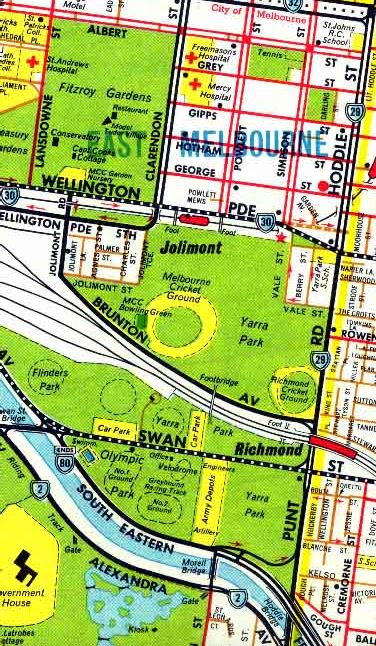
1966 Map of district
Originally an area of multipurpose activity. The fields were used for all types of sports at one stage a  motordome was built which hosted motorbikes on the track and Aussie rules, wrestling, rugby union, and dirt bikes on the in-field. The motordome was torn down in the 30s and replaced by a boarded cycling track and was renamed ‘Olympic Park’, predicting its eventual use by 20 years

Once, Olympic Park was modified again, with two arenas (Conveniently called Ground 1 & 2) and an improved velodrome installed plus hockey and soccer fields. The one major structural addition was the Olympic swimming pool, erected on the riverbank at the park’s western edge.

So, as you can imagine Olympic Park was by far busier than the main stadium (MCG) hosting all swimming, diving, water polo, hockey, soccer, and nonroad cycling events

This is how I remember the area as I used to catch the train into the city. All the buildings were on full display as you passed through the Jolimont railyards. The Swimming Centre still displays the Olympic Rings. By then though Ground 2 had been transformed into a Greyhound track, with Ground  1 becoming our premier track and field and Soccer venue. The Velodrome fared less well, becoming a car park.


2024 Map of district
These days, of course, it is a world-famous sports precinct including the Tennis stadiums, AAMI Park (velodrome/Ground No.1), and Collingwood headquarters main training track (Swimming centre/ Ground No.1). All venues all doubling as entertainment venues from Rock shows to Opera and Monster trucks to Circus’ as well as major sporting codes.

Other venues for the 1956 Games were the Exhibition Buildings, which due to heritage protection still remains as it did in 1956, almost the same as it did in 1888 for that matter. However, for the Olympics, a stadium annex was built, which along with some temporary seating, was all that was needed to prepare the venue for hosting the basketball, wrestling, and weightlifting.

Another unspoiled venue is the St. Kilda Town Hall which hosted the Fencing.

Festival Hall in West Melbourne, was the host of the Boxing and Gymnastics.

When I was growing up Festival Hall was the major events venue for bands, housing shows from the Beatles, Rolling Stones to Frank Sinatra and Liberace. It nearly wasn’t an Olympic venue as it burned down in 1955 but was quickly rebuilt in time for the Games. It has been upgraded to a more modern facility and it still operates today.

The Sailing was held in Port Phillip Bay, which is obviously still with us today and all the rowing was held in Ballarat on Lake Wendouree, though it had its problems getting ready and complying with international regulations it was a hugely successful event for Ballarat, even though Australia won no medals. I first visited it in the drought years of the mid-2000s when it was virtually a field, but going back recently and seeing it full made me realize how wonderful and idyllic a venue it must have been.

The Shooting was held at the Williamstown Rifle Range, it is now a housing estate.

Venues used for 1956 events

The modern Pentathlon was held in three venues, shooting at the above-mentioned Rifle range, fencing at St Kilda, and two other disciplines, swimming and running at Olympic Park, whilst the show jumping was held at Broadmeadows at the Oakland Hunt Club, which still exists today as a riding school. It was the only sport where horses were used in the Melbourne Games as local horses were supplied for the athletes. All other Equestrian events were held in Stockholm Sweden due to Australia’s strict quarantine laws. Something that doesn’t seem as much a problem these days, judging by the amount of foreign horses in the Melbourne Cup.

Originally published in BBCN Issue 334 July 2024

Saturday, 1 June 2024

VBirds

 VBirds

VBirds were a British virtual girl group, created in 2002 by a team of designers, producers and musicians. An animated television series of the same name, consisting of six one-minute episodes, aired on Cartoon Network between long-form programming. The band's only single, "Virtuality", was released on Liberty Records and reached No. 21 in the UK Singles Chart in early 2003. 
A spin-off series of dance tutorials, VBirds: Perfect,] aired in 2003. Despite its success as a promotional tool to keep young viewers watching during ad breaks, no further singles were released. One could almost claim they were created to capitalize on the success of Gorillaz. 
The band's backstory revolved around them being exiled from their home planet of Planet V by its ruler, King He:Lin, for refusing to participate in the dance farms on their planet. They were shrunk down in size and put into a dance machine which was launched from the planet down to Earth, so the humans could play with them as long as they wanted. The story concluded with He:Lin's echoing words "Enjoy yourselves while you can, VBirds. For you will never escape your dance machine prison!" The VBirds were interviewed on SMTV Live. In the interview, Bling and Wow compare their music to that of fellow girl groups Destiny's Child, Mis-Teeq and the Sugababes. 

 Members

 • Boom is perhaps the most witty and energetic member of the group, although she can also be very bad tempered. Boom is able to create and throw pulsating balls of colour by blowing a kiss into her hand. This gives her a knack for decoration. 

Wow is the most mature VBird. Her powers calm those around her, allowing her to keep most arguments under control. 

Bling is the most fashionable of the girls and can easily show it by using her powers to create new costumes for the group in an instant. Although this ability comes in handy for the group during performances, she prefers to use it in her free time to annoy the other girls.
 
D:Lin is the youngest in the group, and with green skin she stands out more than the other VBirds. D:Lin loves nothing more than DJing whenever the group is not performing, and she also uses records as throwing weapons whenever the situation calls for it.

Music

"Virtuality" is the group's only single. It includes the B-side "Dance With Me", which samples the Woo! Yeah! portion of "Think (About It)" by Lyn Collins and vocals from "Virtuality". A music video for "Virtuality" was also released and included in select versions of the CD single.

VIRTUALITY


An episode.


Source: Wikipedia & youtube

Wednesday, 1 May 2024

Emerald Lake Experience.


As I keep writing, one of the perks of retirement is being able to visit popular places and events during the weekday when crowds are at a minimum. And let’s face it. Nothing is better than a stroll in the park on a warm late Summer day. Originally part of the Gembrook Nursery, Emerald Lake park still carries traces of its beginnings through the huge amount of mature deciduous and other non-native trees. This is a legacy of the nursery's ornamental garden that dates back to the beginning of the last century.

 It is truly amazing how the area incorporating the road from the main entrance passed the lake is still strikingly similar to what it was in a Rose series photograph taken in the 1940s.


Taking paths that lead west from the car park leads you through shady groves that follow the small creek with trees that have matured over the hundred-plus years they’ve been left to thrive with the tall ferns and gums. This eventually will lead you to the Emerald Museum & Nobelius Heritage Park. The museum is an immaculately kept building and is a treasure trove of historical artifacts from the area and its past. The surrounding garden, which also teems with history includes a 120-year-old Kiwi fruit that was introduced by the nursery's founder Carl Nobelius and still bears fruit today. Just above that is the original packing-shed siding for the nursery that Puffing Billy still passes by today.

Heading back to the eastern side of the car park below the main sloping lawns with its three amphitheatres is the main body of water Lake Treganowen, surrounded by walking paths with its paddleboats and protected wading area it all gives off the feel of a British period television show. You know you’re walking around the Dandenongs when you encounter stone pillar shelters with wooden picnic trestle tables. Another thing I found fascinating, while I’ll admit others will not, is the toilet block architecture which is like a history lesson of park amenity construction through the century. From the original block between the lake and the main road used as a toilet/ changing room for swimmers when the park officially opened in 1941, to the more besser brick building and patterned brick supported by round wooden poles construction in the Café and Bandstand area respectively that date between the 1950s and 1970s which also double as changing rooms. Though these days for the wading pool only, as swimming in the main lake is forbidden. And last, the more modern Nobelius block which is newer but made to look more in sync with the environment with its wooden structure and grey colours.

While the park has its mid-century charm, it’s the new area that has been built to enhance the Puffing Billy experience that really surprises. The Lakeside Visitors centre has been built to blend in with its surroundings. Next to the lakeside station and below the model railway shed (which, sadly, was closed the day of my visit), It is a vast area that services the multitude of visitors who disembark off the train waiting for the return journey. The building is open and airy, giving the impression of a large railway goods shed, which I’m pretty sure was their full intention. Walking from the station, the expansive opening invites you in and the design of the building promotes a natural traffic flow that takes you passed the ticket /information box and gift shop toward the huge café that is more than capable of dealing with the massive weekend Puffing Billy crowds. All along the way are quirky artworks by local artists.

However, what I found the most fascinating was  Lakeside Hall. A museum dedicated to the history of Puffing Billy and its multitude of volunteers.

Like most retired gents my age, I’m a sucker for old trains, but this even held my wife’s attention. The main feature, to me, besides the wonderful set pieces of train artifacts was the interactive display featuring a video narrated by Shane Jacobson and featured the partially restored but animated remains of one of the original trains used on the line the famous “3A”. A truly fun experience.

I have made a mental note to come back later in Autumn to catch the changing of the colour when the trees are shedding their leaves. I’d come for that even if there wasn’t a model railway exhibition to catch up on.

Originally published BBCN March 2024 Issue 330

Monday, 1 April 2024

Far North Queensland Tales - Crocs, coconuts, boats, and bears.

 Far North Queensland Tales - Crocs, coconuts, boats, and bears.

Last May we were on our yearly trip to Port Douglas, well, when I say yearly, I went there last year, and since we went again that qualifies as an annual event. I guess?

Anyway, on this visit the wife and I decided to take a river cruise to see if we could scope some infamous North end crocodiles. Fun fact: It has been estimated that worldwide about 1,000 people are killed by crocodilians each year,

Australia has a large population of crocodiles, but the research has shown, there are only an average of less than two attacks a year.   Coincidently while we were there, the local newspaper’s front page headline revealed human remains were found inside two crocodiles and was believed to be those of a missing fisherman. So technically, our chances of not becoming reptilian munchies had vastly improved.


This was great supplementary information for our captain/guide who while taking us out on his little boat dressed up as an old paddle steamer told some interesting and wonderfully funny stories on our trip.

We took off from Port Douglas Marina under a noonday sun and a strong breeze that had finally sprung up to take the bite out of the humidity.

The boat took us down Packers Creek an estuary that doubles as a parking area for passing yachts, it is also the designated area for all small and larger sea vessels during a cyclone. It is said when that does happen the whole waterway can turn into a game of tetras. This time of year, cyclones aren’t much of a problem and many yachts come here not just to moor but to hang out for months at a time. It’s kind of like a homeless shelter for yachts. Considering some of these crafts can cost over $50,000 it’s quite a shock to see them looking like something from the streets of Los Angeles. Apparently, they are also illegally overstaying, but since the water police don’t come here often, they just hang around until they want to leave. It was in stark contrast to the multimillion-dollar super yachts all lined up and sparkling in the sun in the Marina proper.

Along the banks are signs warning visitors of the dangers of crocodiles in the area, but on all signs just below the big red warning is a dark  ACHTUNG! The reason was - so our captain told us- that it was due to 40% of those involved in croc attacks being German tourists, and the local authorities thought they better take some kind of action to lower that number. He also recalled how recently another tourist with a broad accent stuck his head in the cabin and said: ” It’s the same back home in  Canada, of all bear attacks, 45% of them are also German tourists”

Something to ponder.

Crocodiles were thin in the water this trip as it was perfect weather for them not to sun themselves on the mud flats. But luck was on our side when our eagle-eyed guide saw a three metre specimen resting on the bank a hundred metres or so up the waterway. He cut the engines and we drifted up and got nice and close, and we got lots of photos. 

On our return trip about fifteen minutes later he was gone. I made a mental note not to dangle my hands or feet in the water. I do have to stress however as we moved down the river, the grey of the mud flats, the bright green of the mangroves, and the brilliant blue sky made the tropics experience complete. All I needed now was a winged-backed cane chair and a daiquiri.

Before we knew it, we were back at the marina and as we disembarked the captain asked what we were doing for the rest of the day. I said we were going for a walk down on the beach, it’s so peaceful with all the palm trees lining the sand. He told us to be careful because the wind was picking up, and that can be a concern as falling coconuts take out more people than Sharks and Crocs combined. I assured him we would. As I left, I couldn’t help but start thinking. What percentage of those knocked on the head by coconuts were German tourists?


originally in the BBCN issue 326 Oct 2023

Friday, 1 March 2024

Sightseeing in Middle Earth

 Sightseeing in Middle Earth

I thought I'd bring this one out again for old times sake.