More interesting stuff from around the place where I live.
The Chandelier tree.
For more of these articles see LOCAL HISTORY in the ARCHIVES tab.

Originally published in the BBCN August 2013
More interesting stuff from around the place where I live.
The Chandelier tree.
For more of these articles see LOCAL HISTORY in the ARCHIVES tab.

Australian artist/satirist Harry Gold is an underrated Youtuber who has work that has appeared in MAD magazine and is a 2D animator for Alt.vfx . I'm posting this because I think it is brilliant and deserves a bigger audience.
Not that he'll find it here.
Local Comic Creator Day April 2021
You know
when things are getting back to pre-COVID normal when people can come together
to celebrate their hobbies and interests that are not related to a church or a
sporting event.

Before the
pandemic, Melbourne was awash with exhibitions, conventions and “swap meets”.
There wasn’t a weekend that went by that didn’t have some event scheduled.
Antiques, quilting, cars, toys, records, cards, many bundled together as
collectables fairs. Some of the biggest of these events (along with the quilting
and home shows) were the pop culture conventions. Events like Supanova, Pax and
Oz ComiCon are annual shows that ran the whole weekend including Friday and
attracted 20000 people a day. Ironically, the venues where these shows are
usually held -The Exhibition building and Centre-are now the venues for the
mass COVID vaccinations.
As well as
these 3 massive pop culture conventions were several smaller lowkey versions,
but as the big ones became larger and more expensive to be part of, or enter,
the smaller ones became dominated by Identity Politics and became somewhat
exclusive.
So, after everything shut down Alternate Worlds co-owner Joe Italiano entertained the idea of running his own comic convention when things began to return to some
 |
| Joe (Left) & Peter Hughes- owners of AW |
On April 17, Melbourne had its first comic
convention in nearly 18 months at Alternate Worlds in Bayswater. Under
the more accurate title Local Comic Creator Day.
So, like
the fanboy I am, I strolled down the road to pay it a visit.
 |
| Gerald Carr |
 |
| Gary Dellar of Reverie |
As the show
was being held in the warehouse adjacent to the Alternative Worlds shop,
space was at a premium, but it added to the cosy atmosphere and the shop still
managed to set up a display of classic Australian comics and magazines, some
worth several hundred dollars and important parts of this country’s publishing history.
I will admit it was a nice change not being surrounded by 50 stalls selling Pop
Vinyl figures and dodging people dressed up as the Hulk, Thor and Spiderman
or 25 different girls dressed as Sailor Moon in every aisle.
It was
pleasant to go back to the roots of the comic convention scene, to meet the
creators and check out their work. Because I know in a year or two it will be
back to full bore circus mode.
 |
| Young Edna |
It’s like some weird six
degrees of separation that involves Miss Walling and me.
I recently found out from a Facebook group dedicated to the
suburb where I grew up, that within 200 metres of my family home in Jordanville (now Chadstone were
two Edna Walling gardens.
Our house was on the very eastern edge of the Housing Commission estate and up the hill situated on the aptly named Grandview Parade was a very fine property called Robin Hill that was so out of place it resembled the mansion above the suburbs in the movie Edward Scissorhands. The home belonged to Lewis B Milne an executive for the company that owned Skipping Girl Vinegar. The house was built in 1946 during the height of Walling’s popularity. In its position, it commanded views almost equal to that from the top of Mt Dandenong.
The original owners had long sold it and moved on before I arrived. The Commission estate began construction in 1949 and the view from the front yard was rapidly changing, instead of empty paddocks was now rows of concrete houses.
I’d
move too.
 |
| Robin Hill today |
But it was there, I’ve seen the plans.
 |
| Robin Hill before the estate with acres of paddocks.Circa 1946 |
 |
| Robin Hill (highlighted) during construction of the Housing Commission estate |

 |
| Edna at work |
Interconnecting Universes.
 |
| Tudor Village at Mawarra Sherbrooke |
 |
| Jamin building the Village |
 |
| The Village prior to installation |
 |
| Before |
 |
| After |
A new home another connection
There are a few local connections
to Miss Walling. When she was in her mid-20s she established a residence in
Mooroolbark and named it Sonning.
This became her base for almost 40 years establishing her nursery and gathering around
her a group of like-minded people for whom she designed picturesque 'English'
cottages and gardens. She named the area BickleighVale village in honour of the town she grew up in
England. It became a sanctuary of sorts and its residence were predominantly female. The village still
remains, and its roads are still unpaved, it was and remains an extraordinary
experiment in urban development.
 |
| A retired Edna |
Edna
Walling’s style was influenced by her memories of the English gardens of her
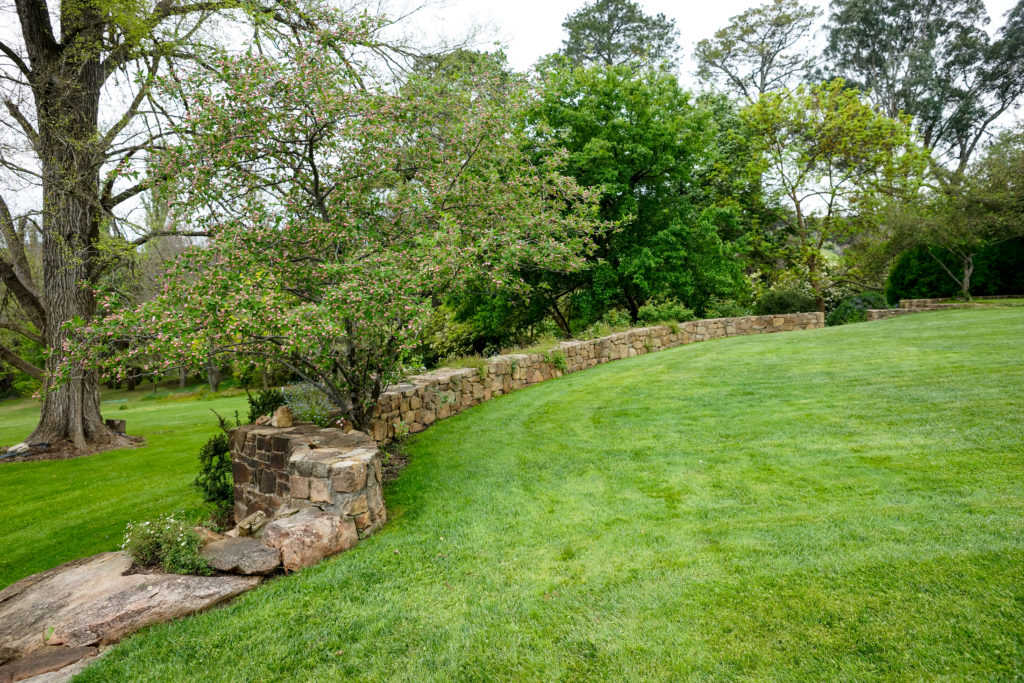
childhood, the stonework of the aptly named Ellis Stones and her love of
Australian flora. Her designs were often water coloured to give clients a more
intimate feel of how the finished garden would appear.
 |
| The Boronia Garden for Mrs Cook |
 |
| An example of Walling's water coloured plans |
Walling
left Melbourne in 1967– though she travelled far and wide during her
career for her work- to the warmer
climes of Queensland and died in 1973.
Edna
Walling was truly a great Australian who left a massive legacy and I recommend
researching or even visiting her existing gardens in the area if the chance
arises just like I have, thanks to a few chance events and some great memories.
EXAMPLES OF EDNA WALLINGS WORK



Bibliography
www.adb.anu.edu.au/biography/walling-edna-margaret-11946
Wikipedia
State Library Walling
Design archives
www.bickleighvalevillage.com.au/
VALE JAMIN SWANEVELD
Artist extraordinaire, extraordinary human.
 |
| Photo credit: ASHLEIGH WEBB |
Jamin was a creative giant in the area. A talented artist who drew and sculpted, this combined with his builder's background created amazing fantasy and whimsical pieces. He went on to become one of the most respected tattoo artists in Australia.
A man who touched people not only with his talent but with his genuine good nature and personality.
I first met Jamin when I first moved into the area nearly two decades ago. He had just opened up a space next to a Nursery called WillowWoods in Belgrave to showcase his art. It was a magical place. A hexagonal cabin surrounded by fantasy-themed gardens with a bridge crossing to a little nook over the creek. Inside where sculptured models of wizards, dragons with other items like birdhouses books with ornates covers and random items like swords, helmets and shields, and smaller pieces like mushrooms and candles. I would pop in a just chat about anything, he had that charismatic personality and being a natural storyteller, he could hold an audience for ages.
Sadly, WillowWoods didn’t pan out as planned and Jamin took a leap into the great unknown and decided to start up his own tattoo parlour Last Frontier in Upwey. A passion that combined his natural talent in drawing, patience and his natural rapport with people. Within a decade he had become one of the most respected skin artists in the country. He had built a unique shop, a cabinet of curiosities that was a million miles removed from the type of establishment often associated with the industry. With this success came the ability to travel and research the art he so much loved. His unique style and willingness to work with customers made him hugely popular. During COVID, unable to work from the shop, he decided to move the business to his home in Cockatoo where he rebuilt the shop's fantasy interior in a separate studio. This was all to be ready to roll out early this year but sadly this will no longer take place. Besides being an artist and builder Jamin had a passion for cars and motorcycles. He had two projects an old 1952 Ford pickup and a steampunk themed Harley motorbike that was showcased in national magazines.
The world has lost a wonderfully creative talent and a true gentleman, a man whose passing has affected many in the community as they realise how much a change he made in their lives and I cannot begin to understand the loss his family is suffering. But if you reap what you sow in this life Jamin is currently walking through a field of gold.
Rest In Peace great man. I'll see ya when I'm looking at ya.
OTHER ARTICLES THAT JAMIN APPEARED IN THAT WERE PUBLISHED IN THE PAST.
Willowwoods -Where I fist met Jamin and how he inspired me to start creating again
Jamin the Artist An early article of his move to Last Frontier
Last Frontier A review of Last Frontier.
My Hobbit Hole That time Jamin gave me his unfinished Hobbit house from Willow Woods.
d'Arcy Doyle Aussie Everyman Painter


So, while Doyle’s
prints and ephemera are not as prevalent as they once were, he still has a big
stake in the future of other artists and he has left his mark on my memories
even though it was only three or four works it’s probably influenced me more
than most artists in my life.
Originally printed in the BBCN Issue 297 March 2021 edition


