Sunday, 7 July 2019

The Record and Music Market


The Record and Music Market

 I like to think of myself as a collector, but the truth of the matter is that I am more of an accumulator. I have varied interests, I like books and music and comics and films and books on music and films about music and books about film and music from films and comics from books. You get the picture. Things accumulate.
I have a book library in the hallway. A CD library in one of the spare rooms, and in my study my collection of dead rock star figures, musical instruments and more books and paintings and posters and not a lot of wall or floor space.
So when I saw an advertisement for a record and music memorabilia fair at the local antique market I thought to myself: “That seems like a great way to get rid of some of my accumulated collective material.”  In that, what I really meant was all the stuff that was cluttering up my living space and making it hard to sit down, let alone walking in a straight line.
So, convincing myself that if I hadn’t looked at a book or listened to certain music for a given amount of time, or even had two of any particular thing it would go onto a pile to sell.  Now, I don’t actually have a lot of records, I replaced most of them years ago with CD’s so my main area of music-related sale items would be books, figures and ephemera, things like old magazines, patches posters and tickets.
As I gathered these things into a pile in my study, my son came into the room and looked at the stack about two-foot square and about the same in height he asked if I had gone out and have a big buy up and did I really need more stuff?
I proceeded to tell him of the market idea and that this was the stuff I was going to sell. He looked around and wanted to know where did it come from?
Seriously, looking around it was almost as if the cabinets and shelves had let out a big sigh of relief and stretched out now they had more room. Apart from the pile in the middle of the room, it looked like nothing had changed.
The start of the pile of things to sell
I was confident now that I had more than enough to sell and went off and paid my fee at the market. The man there showed me the table I would be using and was glad to see it was exactly the same kind of portable table I had in the garage at home.
So,  when I returned home I took all my stash into the garage and set about organizing my stall. I placed and stacked and rearranged trying to get the right look, or appealing showcase of my wares. I was quite enjoying this when the  wife popped in to see why I was taking so long, when she asked if she could  play shop too, she was banned. It’s my shed after all.
I was getting excited as the date arrived and everyone had a piece of advice. Make sure you bring change, everyone will have fifty dollar bills. People will knick anything, not in your eye line. You’ll get so bored, take a book. No one could dampen my enthusiasm.
I was good to go.
Some of the stall Mine is middle top
The market was being held on the Sunday of the Queen’s Birthday weekend at a large antique and collectables warehouse in Kilsyth and I had to be there at 9.30 AM to set up for a 10.00 AM opening.
The night before I had packed my car up to the roof with my wares, being the long weekend I could only use my Ford Focus, I couldn’t borrow any of the kids larger cars because they had all gone away for the holiday. I got a great park right out the front at 9.30, walked in and got a front row table and started to set up.
Started but never really got a chance to finish.
People started coming in early- as everyone knows the early bird gets the bargain- I looked up from arranging my books and figures and there was a group of people waiting to go through my meagre record stock (all up I think I only had about 25) I didn’t expect anyone to be interested in these as I put more faith in my music biographies and reference books being more desirable.
Nope,
I had people ripping out records and waving money in my face while I was still trying to unfold my camp chair. Things settled down after a while but much to my surprise my vinyl records didn’t last long and the rest of the day was a steady stream of a sale here a sale there just enough not to be able to nick off for a coffee break, so luckily I bought my own thermos of hot sugary milk ( I forgot the Tea bags)
All up I had a good day and made a healthy return on my goods. None of the things that people of great insight said came true and the car was a lot easy to pack up that it was that morning. The guy who had the table next to me, a retired gentleman who did this for pocket money (he also sells a lot online with eBay) said he did well and I suggested he pick a book he’d like and I picked out a CD I didn’t have and we were both pretty happy with the trade.
Apparently, there’s going to be another one in a few months, I’m thinking rather than try and find a spot for the stuff I bought home, I just might give it another go.
originally published in the BBCN Issue 279 July 2019


Monday, 3 June 2019

11 Forgotten Heroes From History's Worst Comics Publisher

This article by Seanbaby originally appeared on CRACKED.COM. I had to repost it here for
 its historical importance and for just being a plain fun article. Hit the link to Seanbaby.com and read some
 of his other informative and interesting pop culture articles. 

11 Forgotten Heroes From History's 

Worst Comics Publisher.


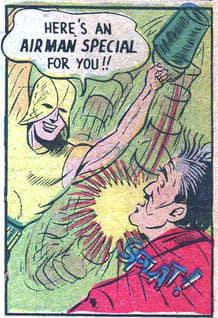
In 1938, Centaur Publications was formed. In the four years of its lifespan, this company produced comics exactly like everyone else's, only crazy and worse. They had sloppy versions of Captain America, Green Arrow, and the Spirit, along with 12 different Flash Gordons and a female Superman named "Super Ann." To give you an idea of their creative bankruptcy, their Human Torch was called "The Fire Man" and their Hawkman was called "The Air Man." He wore a yellow penis costume and fought crime with a bucket, and I can prove it:
"WHAT? WAIT! PLEASE EXPLAIN EVERYTHI-" *SPLAT!*
Most of Centaur's knockoff characters were forgotten until the early '90s, when Malibu Comics rescued them from the public domain to be forgotten again in the mid '90s. But in between their sad takes on Wonder Woman and Tarzan, they generated some uniquely insane comic book heroes, and some of them are worth another look.

11
Minimidget The Super-Midget


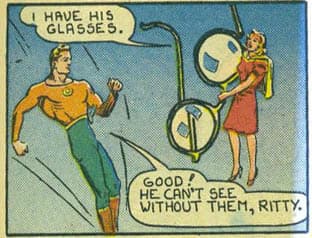
Minimidget the Super-Midget was very small, and I'm now done listing his special abilities. It's hard to express how difficult this made his life. His adventures usually involved him trying not to die from curious turtles or spilled coffee until he stumbled into crime he had no way to deal with. Ever. The writers dreamed up this awesome idea of a little man, but never solved the issue of how he would fight regular-sized crime. This meant the climax of every single Minimidget story was seeing how he would call someone, anyone for help. Minimidget the Super-Midget was a weird, useless speed bump in the plot of his own comic. He also had a tiny sidekick Ritty, who was three inches tall, a woman written by men in 1938, and just never had a goddamn chance.
"OH, WHY YES! YES, OF COURSE, MINIMIDGET! THANK YOU FOR EXPLAINING MY PLAN TO ME!"

10
Dr. Hypno


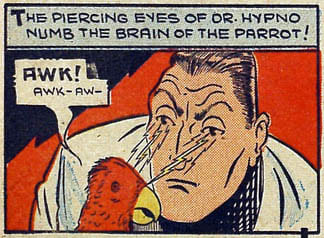
At this point in time, there were hundreds of colorful crime fighters with amazing abilities. Dr. Hypno, on the other hand, could mind-control up to one animal. He only needed two things: someone trustworthy to watch over his lifeless body and an already-calm animal. He basically had all the powers of a dead animal trainer's legacy.
To make matters more complicated, Dr. Hypno did not live in the woods, where cougars and nighthawks could be sent to destroy his enemies. He lived in the city with a Chinese slave, and when he transferred his soul into parakeets or house cats, all this did was add a deranged and unnecessary step to an otherwise normal event. The people around him seemed less in awe of his abilities and more in awe of how this pervert always found some excuse to stare into the eyes of a parrot until he became it.

9
Craig Carter And The Magic Ring

In a lucky turn of events, Craig Carter gave up a promising archaeology career to pursue fighting crime full-time, and THEN found a ring that let him command gods from any religion. That's basically the end of the tension, because he would never encounter a criminal who could deal with Zeus.
So it became a little suspicious when the comic kept running and Craig kept calling on these shirtless muscled men from ancient lore to solve problems an ordinary punch or a parrot containing the mind of a man could handle. If Craig was exploring a cavern, he'd summon Hermes, the God of Wearing a Hat and Nothing Else, to carry him. And if he was infiltrating a mob hideout, who better to help with a stealth mission than a gigantic, mostly nude Thor the Thunder God!? The point is, Craig Carter went to elaborate lengths to convince everyone it wasn't a magic fuck ring.

8
Ed Smith In The Air Corps


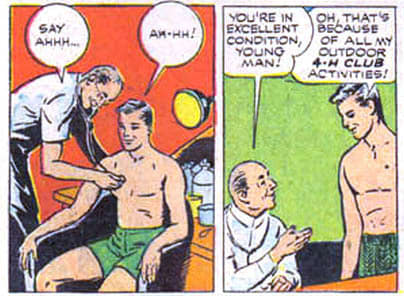
In a comic they published for the Chicago Mail Order Company, the Centaur creators were tasked to create a character specifically to promote C-M-O's easy-to-use savings. Proving there was no possible way to get fired from Centaur Comics, they landed on "Ed Smith." Young Ed had no enhanced abilities, but he enjoyed hobbies and activities, and honestly, it's not safe to tell you any more. Ed Smith didn't do fucking anything. He was so soul-crushingly generic that Nazi scientists described him to American prisoners to dissolve their genitals. If you clap when someone drops a plate in a restaurant, the organizer of your Oscar office pool would accuse Ed Smith comics of containing a demonic level of dullness.

7
Plymo The Rubber Man


Oh no. Hey, you kids get the fuck away from Plymo, the Rubber Man.

6
Speed Centaur

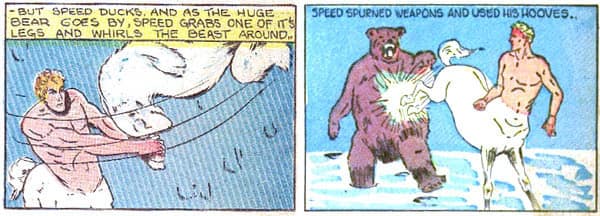
Sleek and nude Speed Centaur was the sole survivor of an arctic horse-man city, a chum of ideas thrown together by lunatics and then drawn by less-talented lunatics. Every issue of Speed Centaurfelt like it was written by a different Make-A-Wish child dying from early onset stupid. Most times, Speed was confused by our shirted, man-legged world, but other times he was a genius detective. He could fly, though not always, and one time he turned into a regular horse through sheer lack of coherent vision.
He mostly generated "Mystery Horse Tramples 15 More to Death" headlines, but he also somehow found a way to beat a bear to death every issue. The creator of Speed Centaur definitely listed his two greatest influences as "a lead-paint-eating contest" and "defending my lead-paint-eating contest championship."

5
The Rainbow

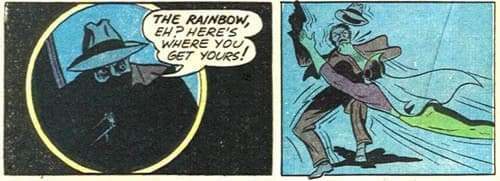
For no real reason, a man named Jim Travis, whom the comic generously described as "Jim Travis, college graduate," decided he wanted to be a comic book superhero. His girlfriend simply stated, "BUT YOU'VE GOT TO HAVE A COSTUME AND YOU'VE GOT TO BE A HE MAN." Jim missed this brazen slap to his manhood, and that very night, with no training or fucking anything, became the Rainbow.
And since this was 1941, the story wasn't an exploration of man's capacity for delusion. Everything worked out, and his first adventure ended with a woman exclaiming how she's sure to see him again, his "arch-enemy" Black Rufus vowing revenge, a promise of thrills and excitement next issue, and then the Rainbow never appeared again. That's how bad Centaur Comics was at everything.

4
Captain Jim


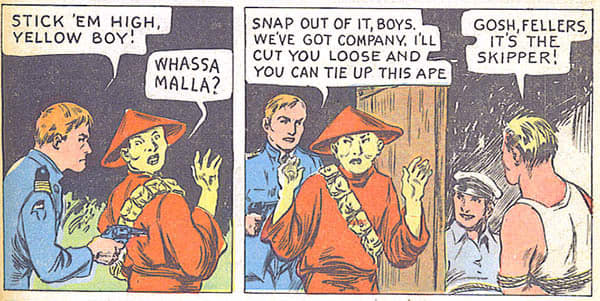
Captain Jim was the skipper of the SS Patsy, and he the only thing worse than his judgement was his racism. His ship was in a constant state of pirate occupation, which may have been on purpose so he could kill foreigners with his knives and teeth. This is where he did OK. Jim was a shitty captain, but he was a tornado of hate crime in a fist fight. He had so many fucked-up ways to call someone "Chinese" that I had to look four of them up. By the time Captain Jim was done crossing any body of water, it would technically be described as a wet pit of bright yellow corpses.

3
Dopey Danny Day


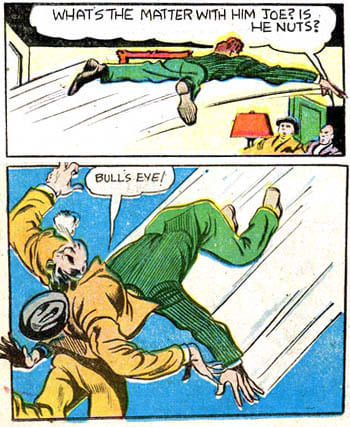
"Dopey" Danny Day was a reporter with no notable talents who badly lost every fight, and the closest thing he had to a personality was how he suffered two concussions per page. But in one issue, possibly because his brain could no longer register trauma, it occurred to him he could turn his life around if he answered every question with a headbutt to the dick.
That guy literally mentioned the word "nuts" before getting hit in the junk, and Danny didn't even pick up on it.
After that event, Danny leapt headfirst into everything. Sometimes he hit a dick and things went his way, and other times he hit something harder and lost a little bit more spinal fluid. Overnight, this comic went from a waste of everyone's time to the life-and-death struggles of a man who could only dive full-power at dicks and hope for the best. That's a story I always want to hear the end of, and the exact technique John Travolta uses to decide on movie projects.
RIP "Dopey" Danny Day 1939-1940
"Thank you for the membo soggy, hi, many yes of these head wounds are from penises, good night."

2
Headless Horseman

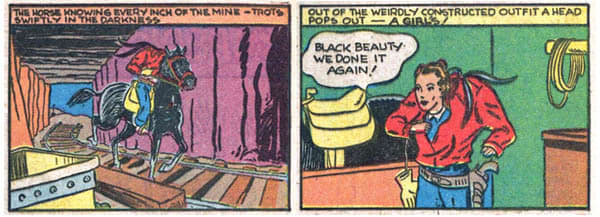
The Headless Horseman was a crime-fighting cowboy who wore an ascot tied to no neck and screamed from an empty space with no mouth. What dark witchcraft called on him? How does he see or hear? Does he eat by dropping animals into his collar or soaking his entire shirt in soup? Well, when a stunning twist reveals he is actually a girl with a six-inch torso and toddler hands on the end of octopus shoulders, those are going to seem like silly questions.

1
Copper Slugg

 Continue Reading Below
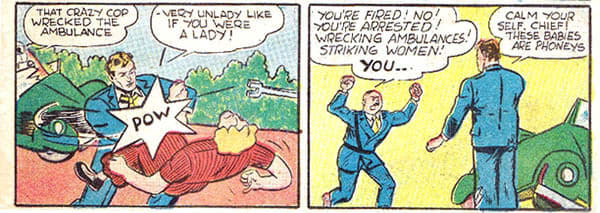
From what I've learned from comic books, punching was the "happy holidays" of the 1940s. It was very common, it worked as a fine hello but better as a goodbye, and only uniquely lame pussies had any issue with it. In the '40s, you could beat a man half to death and tell the police, "Wait a couple days 'til the swelling goes down on this mook's face and see if he's yer guy. Also, yer welcome." If a magical wish transported you to a Golden Age comic book right n- PUNCH. That's how regularly it happens. So it's very strange that Copper Slugg's entire thing was how he punched people too often.
Slugg only appeared in one eight-page story, and in that time, he punched five men and one woman, with three -- possibly four -- of these incidences being total misunderstandings. And make no mistake, they were pissed about it. In the tens of thousands of Golden Age comic book stories, Copper Slugg was the only guy who ever got in trouble for punching because the punching itself was wrong. No matter how you feel about violence, that's inspiring. He punched so many people that the laws of his universe had to rewrite themselves around him.

Saturday, 4 May 2019

Free Comic Book Day 2019. Alternate Worlds


Free Comic Book Day 2019. Alternate Worlds

Free Comic Book Day (FCBD) had a double impact this year falling on Star Wars Day –May the Fourth (be with you). The worldwide day of celebrating the local home of all things comics and pop culture has now been going strong for 17 years and usually coincides with the release of a comic based blockbuster movie. This year of course is the massively popular Avengers Endgame, which at the time of writing is headed to being one of the biggest grossing pictures of all time.


It would be nice to say these blockbuster movies worked their release days around Free Comic Book Day but in fact, FCBD was actually started around the release of the first Spider-Man movie back in 2002. Despite this FCBD is still a popular date on the calendar and has turned out to be a great family-friendly event.


Some comic stores in the city centre have lines reaching over two hundred metres long before opening but out here in the outer suburbs, it’s a bit more laid back. My local comic book store Alternate Worlds in Malvern Street Bayswater. The day tends to be far busier than normal but without the crazy crowds that seem to descend on their big city counterparts.
Peter Hughes reaction to the big crowd
However, this year was a little different. Alternate Worlds were a lot more inclusive this year, with special prizes for kids under 12, in the way of costumes and trivia contests but for us more mature fans, owner Peter Hughes and Joe Italiano displayed some of their more collectable comics in a million dollar plus exhibit of rare and historical comic books, many from Joe’s private collection.
Joe Italiano and the Million Dollar Wall
It was wonderful to see parents strolling around on a Saturday morning with children as young as three and four dressed as Iron Man, Thor, Spiderman among others flipping through comics seeing which one they want to take home. The Dad’s as excited a the kids in some cases.
Every year the many comic book publishers issue special comics as samplers, stand-alone issues for those new to comics featuring old and new characters. Surprisingly not the more popular movie based characters, which I like, as it feels less exploitive.


The Million Dollar Wall
But this year I was excited to catch a glimpse of these rare comics on display. I have a love of comic book history predominantly Australian but it’s always nice to see something so rare that they have the same price as a small house. Because believe it or not, old and rare comics are commodities much like wines, coins and books these days and can command huge prices at some of the most prestigious auction houses. As an example, the original comic in which Superman first appeared – Action Comics No.1 was last sold in 2014  at over 3 million US dollars.
Whilst that particular comic wasn’t on the board, there was in no particular order. Amazing Fantasy No.15 1963 (the first appearance of Spider-Man) Action Comic No. 252  1959 (the first appearance of Supergirl)  Tales of Suspense 1963 (The first appearance of Iron Man) Superman No.8 1941 and Batman No.9 1942 (Both 1940s editions of the world-famous heroes when they were first starting out) and Captain America No.15 1942 (with the slightly racist war-time  title Nazi’s & Nips) A quick search on Google in the price guide sites and you soon realise why they called it the Million Dollar Wall.
Though a more subdued celebration of Free Comic Book day, Alternate Worlds still made an occasion of it but I have no doubt local comic book shops the world over had a big boost in sales this weekend.

Monday, 1 April 2019

OZ Magazine Sydney edition.

OZ Magazine Sydney edition.

Most people who have an interest in Australian cultural history are well aware of Richard Neville, Richard Walsh and Martin Sharpes OZ that caused all kinds of upset in 60s London. The University of Wollongong have -for the sake of research and cultural significance-  uploaded all copies to their website to be accessed for FREE.
But the added bonus is that they have also got permission to display the original OZ magazine from the early 1960s printed in Sydney before the lads took the idea overseas.
Here it is in all its glory , just click on the link.

 OZ Magazine Sydney

The do-it-yourself style of the early OZ is a beautiful hodge-podge of cut and paste craziness that still inspires designers today.
If you click around a bit further on the site you'll even find the whole collection of OZ Magazine London.

Friday, 1 March 2019

Len Lawson The Real Life Comic Book Bad Guy Part One

Len Lawson The Real Life Comic Book Bad Guy Part One


This article is a compilation of several articles previously written on Leonard Lawson all focusing on different aspects of his life, whether it be his time as a popular comic book artist, the censorship in the comic book industry of the era  or the resulting criminal cases arising from Lawson terrible deeds. I have arranged and edited them to give a more encompassing story of the man who could’ve been Australia’s greatest comic artist to a man who died in prison of old age.
The articles are listed here for reference.


Len Lawson
In  both M. Night Shyamalan movies Unbreakable (2000) and Glass (2019) Samuel L Jackson plays Elijah Price or Mr. Glass , a superhumanly intelligent mass murderer and comic book theorist with a degenerative disease that makes his bones brittle and makes normal mobility and interaction in society almost impossible. Glass is a supervillain who uses comic book stories to construct intricate scenarios that he plans to the nth degree in complexity. Where this could technically call him a comic book villain Australia lays claim to a real-life comic book killer, once an extremely popular artist and writer Len Lawson.
Leonard Keith Lawson went from highly paid successful comic creator and supposedly happily married family man to national disgrace in one crazy act of madness that landed him the death penalty and then released after seven years to commit more acts of an appalling nature that his convictions went on to make him the longest serving inmate in Australian history and eventually dying whilst incarcerated.

EARLY CHILDHOOD
Leonard Keith Lawson was born in 1927 in Wagga Wagga. His parents, Keith and Eileen, were both just 18 when they married and had him. Keith was a local celebrity because he was a talented boxer known as the Wagga Walloper.
Young Leonard — known to all as Len — was a gifted student, topping his classes. But his real talent was art. Len was a natural artist combined with a passion for drawing that his precocious talent showed very early.
In the early 1940s, the Lawson family moved to Manly. There, at age 15, Len scored his first commercial success as a comic book artist when he won a national competition run by artist and publisher Syd Miller, himself famous for co-creating the iconic Chesty Bonds character.
Len’s comic told a war story set in the Pacific and was included in an anthology published by Miller. On the back of that success, Len started studying art in Sydney.
By February 1945, he had published a full-length adventure comic called Peter Jury, which was included in Syd Miller’s Monster Comic publication, whose subtitle was “For Australian Boys”.
“Len is only 17 years of age and has promise of becoming one of Australia’s leading comic artists,” reported Wagga Wagga’s Daily Advertiser.
Len was precocious personally as well as professionally. Just like his own parents, Len was 18 when he married Betty Jamieson, also 18, in September 1946.
The following month, Len got his biggest career break when he wrote and illustrated all the stories in the very first issue of Action Comics, published by H.J. Edwards Pty. Ltd.
Readers were thrilled by the science fiction tale of Spencer Steele, who was exploring the universe in the far-off future of 1956. Then there were the thrills of speed racer Johnnie Star and the adventures of detective Michael Justus.
As a bit of background, the Australian comic market consisted of mostly American imports prior to the 1940s. After the start of World War II, the Australian government banned the import of American comics and Australia was able to develop its own local comic industry. At the conclusion of the war, Australia found itself with a large national debt and a determination to support local businesses. As a result, the Australian government kept the import restrictions in place. This gave Australian comic publishers no competition and a captive audience of comic book readers.
With popular characters like Flash Gordon, the Lone Ranger and Tarzan and their respective comics unavailable there were huge opportunities to be taken of in the local market.

Action Comics where the Lone Avenger was top billing.


So, by the second issue of Action Comics, a character debuted who’d become Len’s most famous. The Lone Avenger told the story of a masked cowboy named Paul Nicholls, who dressed in a white hat, red mask, green shirt, leather gauntlets, belt, and boots. The Lone Avenger fought crime: first on the range as a wandering hero
 and then in the town of Redrock, where he eventually would settle down and become Marshal of Redrock. Bull Malone, his sidekick, would become his deputy. An obvious rip-off of Fran Striker’s Lone Ranger
Action Comics had been an anthology but The Lone Avenger soon took over the entire book and would continue his crime-fighting run for 13 years. Kids all over Australia, New Zealand and Fiji joined the fan club and bought Lone Avenger toys and outfits.
Len produced other popular characters for Action Comics, including another cowboy dude, this one called The Hooded Rider, and a wild jungle babe in Diana: Queen of the Apes. But The Lone Avenger had the biggest following, selling 70,000 copies per issue.


LEN THE VILLAIN
By the early 1950s, Len was doing brilliantly. He had a successful career, a happy marriage that had produced three children and he was earning £70 a week, which is the equivalent of $2400 a week now. He seemed to have it all. Except something dark and twisted lurked inside Leonard Lawson.

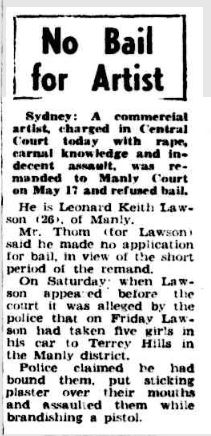
On May 7, 1954, Lawson hired five Sydney models. Two were aged 15, the others were 18, 21 and 23. Lawson wanted them, he said, for a calendar, he proposed to publish. He picked them up from the studio at 9:30am and they stopped in St Leonards to buy some sandwiches, for the day’s supposed picnic ambiance.
Lawson drove them to Terrey Hills and they walked from the car through thick bush. “Of all the beautiful places in Sydney, I don’t know why you had to pick this place to take photographs,” one girl said.
“I am paying for this day’s work,” Lawson responded, “and you will do what you are told.”
This sunny day soon took a dark turn. “When this calendar comes out, I won’t be here,” Lawson told his young friends gravely. “I have cancer.”
The models were horrified and saddened. Lawson told them he was planning to commit suicide rather than endure an agonising death. “I am thinking about putting a bullet in my brain,” he said.
He took a sawn-off rifle from his backpack (in actual fact a pea-rifle, nothing more than a single shot “slug gun”), loaded it and declared he was going to kill himself there and then. Scared and crying, the girls pleaded with him not to. Lawson abruptly turned the rifle on them, telling them to all lay on their stomachs. He was going to tie them up, he said so they couldn’t stop him from shooting himself. He tied their hands and wrists and used sticking plaster to cover their mouths.
Then his true purpose became clear.
Lawson began removing or cutting off their clothes. Telling them they’d each get a bullet through the head if they resisted, he raped two girls, tried to rape a third and indecently assaulted and intimidated the other two.
“I don’t know why I picked on you decent girls instead of street women,” he said remorsefully when he was done.
Lawson untied his victims, paid them each their £6 fee and drove them to Gordon because one girl wanted to go to a chemist.
It was as if he thought what had happened was no big deal. Once inside the pharmacy, the girl called her parents and the police, who descended and arrested Lawson while he was still sitting in his car outside.
The craziness of Lawson’s actions here is the fact that if any of the women had been more astute, they could have noticed the gun for what it was and could have called Lawson’s bluff and walked away or held him to task for his proposed actions. This is not to suggest the girls were responsible for what happened to them, but their submissive behaviour gave Lawson the confidence to escalate his actions. The regret of his actions so soon after the deeds may indicate that he never intended to go the extremes he did. It however still revealed his hidden psychological problems.

COURTROOM DRAMA
In the days to come, Lawson gave seven confessions. But when the case against him on rape charges was heard from 24th May, he pleaded not guilty.
The girls testified against him at length, providing chilling detail of how he’d manipulated them before unleashing his full savagery.
Not true, Lawson’s lawyer said. The girls had all been willing participants in a “burlesque on the theme of rape”. Testifying, Lawson said he’d had sex with some of his accusers but it had been consensual. He did feel guilty — but only because he’d betrayed his wedding vows.
The jury didn’t need to deliberate for long. The Sun’s front page headline simply screamed “Guilty!” over a portrait of Lawson.
Found guilty on two charges or rape and on a further charge of sexual assault, Justice Clancy passed the death sentence, adding he saw no reason why it should not be carried out, although Lawson would be the first man executed for rape in NSW for 57 years.
Only 17 men had hanged for rape, described as a criminal assault, since 1788. The last man executed for the offence was Charles Hines, on May 21, 1898. Lawson was spared, sentenced instead to 14 years jail when NSW Labor premier Joe Cahill abolished the death penalty in October 1954.