Saturday, 8 March 2014

A short history of the Human Powered Vehicle

A short history of the Human Powered Vehicle 

Picture via visual.ly
When I was a teenager and growing up in the 1970s the skateboard craze burst onto the scene, we embraced it, living in a hilly area meant we had heaps of places to practice and go fast downhill. Then come off even faster when we realized we couldn’t stop or got “speed wobbles”.
 I see the shapes and skills of the boards and riders these days as well as the sub culture it has created and never in a hundred years would have thought the sport would have evolved to such a massive social and business model. If I did, I would be now very rich. In my day it was about getting from A to B quicker and unlike a bike, I didn’t have to worry about it being pinched from the railway station. These days you can watch a young person ride a half pipe for hours it almost seems like they are practicing Zen, attaining enlightenment by slowly turning repeating each move going higher and with each repetition achieving something more. That is until the make a mistake and come crashing down from height much like I did in my day.

It is assumed that skateboarding was invented and developed between the late 1940s and early 1950s, no one seems to know who invented the first board but common consensus believes it was a simultaneous event in several beach side areas in the U.S and accredited to the growing popularity of surfing at the time. Skateboarding is the result of keen surfers wanting to still get their fix on flat wave days. The use of old roller skate wheels onto a plank of wood was used to replicate the boards in surf, thus it being referred to “sidewalk surfing” in its infancy. Though the wheels were made of clay and there was no real method of turning, not to mention unless you skated on a smooth surface without and dirt, rocks, sticks whatever you were in fear of coming to an abrupt halt and flying off the board let alone smashing the wheels. Roller skaters could lift their feet, skateboarders couldn’t. This somewhat primitive practice obviously had some merit because skateboards did go into commercial production as early as 1960 an L.A surf shop bought Roller skate wheels and place them on formed wooden boards.
 Though skateboards were still basic in design and basically still roller skate wheels bolted to a surf board shaped bit of plywood by 1965 Skateboarding was so popular it had generated sales in the millions spawned a national competition and national magazines. This popularity was short lived and dismissed as a fad and interest dropped off rapidly, with no competition or national magazines existing by the end of the decade. Development of skateboards never stalled even during this lull period and with the development of polyurethane wheels and the advent of the “Trucks” rubber balls under the T shaped axles to help steer the wheels by shifting weight made the earlier skateboards easier to maneuver and experiments with fiberglass and aluminum. Couple these innovations with cheaper production costs resulted in a spike in the popularity again around 1972.
This time it went global.
One of things that helped this was a combination of social and environmental factors. In California in the early part of the 1970s a prolonged drought had made it necessary for officials to ban the filling of domestic pools, this and the event of the new board technologies worked in the favour of an enterprising Surf board maker Skip Engblom saw the potential in a group of young surfers/skateboarders and created the Z Boys.
The Z Boys went on to set benchmarks in tricks and completions that had never been reached before and created a whole new popularity in skateboarding that traveled the world. All of this is captured brilliantly in the documentary Dog Town & Z Boys.
Thanks to the Engblom’s opportunism and the camera of his partner Craig Stecyk, most of the beginning of this period is faithfully recorded. The creator of the film Stacey Peralta along with Jay Adams and Tony Alva went onto become legends in the field of skateboard history. With this new fame came more completions expanding outside the USA and bringing in competitors from Europe, South America and Australia.
Big money started pouring in and with it more manufactures, specialist and bulk, magazines and movies. The sport evolved as did the boards and the shape changed drastically over a short period of time to cater for new tricks and abilities now being attempted by the elite.
This kind of attitude and sponsorship can be directly linked to the creation of the X games and the popularity of extreme sports, not only BMX and Moto-Cross but paragliding and surf skiing amongst others. People like Tony Hawks have become so wealthy and well known off skateboarding that after more than a decade from retirement from competition he can still draw crowds and be part of the Big Day Out concerts as a major draw card he that well respected.
And it seems that age is no longer a barrier for skateboarders,
I have worked on a project recently with two keen riders who having been bit by the bug in their pre teens are both in their mid thirties. Nick Ford is married with children and does graphic design in Sydney, whilst Scott Robinson a respected commercial artist in Brisbane works with Government sponsored galleries and art programs and recently was given a commission to do a portrait of one of his boyhood heroes Jay Adams. Both are seen on weekends trying to skate down hand railings in city parks. So be careful next time you scowl at some older gent zipping through the park, he may be your accountant. One thing can be sure, Just like our Grandparents screamed at kids whizzing past them on boards our kids are going to be doing the same when they get older.

Originally published in the Boronia and Basin Community news 2010

Saturday, 15 February 2014

THE ORIGINAL CITY LOOP

THE ORIGINAL CITY LOOP
This article grew from a very long road trip one Sunday from Boronia to Reservoir to visit the wife’s parents then off to Chadstone to visit my Mum. Coincidentally each one of us lives very close to a railway station.

When I was but a youngster living in Jordanville (a suburb swallowed by Chadstone that no longer exists except in the hearts of those who once lived there) Though not isolated, it did seem to take a long time or a lot of mucking around to get to from where we were in the South East to the other sides of town; even a trip that would be considered a short 20 minute drive these days.
Living on the Glen Waverley rail line meant getting to the city was relatively easy, though heading the other way was pointless because back in the 1970s Glen Waverley terminated at Springvale Rd and after that was vacant land and orchards.
I remember when VFL Park opened, for quite a few years we traveled in buses on dirt roads to get there. If we needed to go to somewhere like the races at Caulfield or the Dandenong Market we could go to Oakleigh rail station but only if the buses were running. Which they didn’t on Sundays, after 3PM on Saturdays or after 6.30PM most week days of the year. So if you were planning to go somewhere with linking transport, chances were that you mightn’t be able to get home the same way. Going to the beach meant going all the way into Richmond and changing trains. Unless you had a car, (which we didn’t) life was one long journey. Cars were still quite the luxury. Living in a Housing Commission area, most houses didn’t even have driveways and on some Sundays you wouldn’t even see a car for nearly half an hour on busy Huntingdale road. But it wasn’t always like this. Imagine if you lived in Chadstone and had just been accepted into Latrobe Uni after a successful VCE year, you’re 18, haven’t got the 120 hours up and don’t look like it’s going to happen for a while and if you do get your licence the prospect of buying a car is still not an option. What if you’re a young hipster from Reservoir and you would like to visit the Shopping behemoth that is Chadstone Shopping Centre but your Green living ways and environmental friendly lifestyle means you avoid driving and rather catch public transport.
Good luck and take more than a cut lunch.
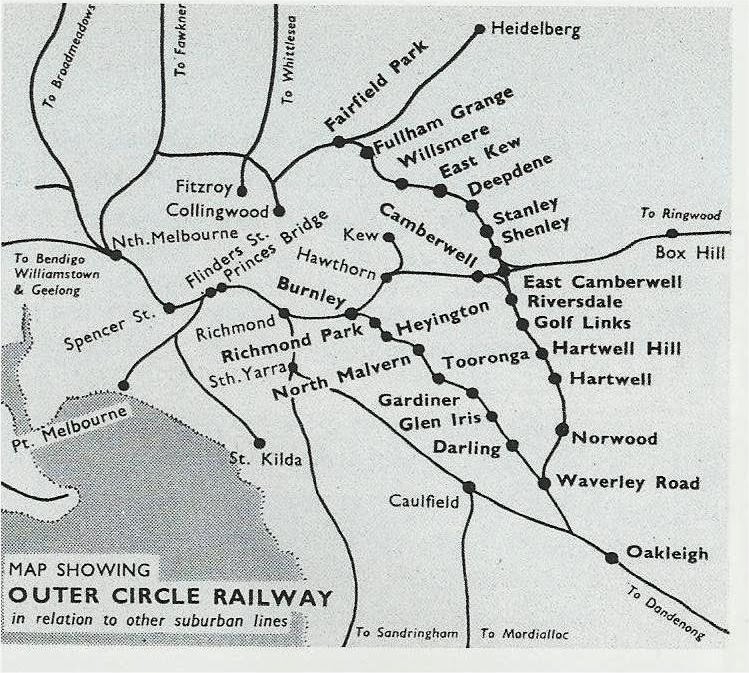
Could you imagine a railway that could get you from Oakleigh via Chadstone onto the Lilydale line just before Camberwell up through Kew then onto the Hurstbridge line where you could go to Latrobe Uni (or very near it) even Victoria Park or the Zoo. It did exist, once.
It was the Outer Circle rail line and it was fully functional before the turn of LAST century. Though Melbourne was founded in 1835 it grew quickly.
Thanks to the1850s Gold Rush the city blossomed to be the jewel of the Southern hemisphere. Melbourne was the Dubai of its time. During the years between 1850 and 1880 Melbourne had become the richest city in the Empire and only behind London in size. A lot of this growth can be contributed to the sudden influx of wealth, population, need for services and resources from the Gold rush but there was also a good deal of self interest and corruption from land owners and Government officials. Our founding fathers had foresight, you just have to look at our excellent reservoir and catchment system that meant we had a lot less of the serious outbreaks of contagious diseases that Sydney had at the same time in history and is still the envy of many major cities of the world of the same size, with a less forgiving climate.
The also knew how to move people around and a railway system was the most efficient means of moving the growing populace and freight that sustained it.
By the year 1900 railways could take you to almost anywhere in the state, with Melbourne, Geelong, Ballarat and Bendigo having their own central systems. So progressive was the system that some had already been closed down as inefficient.
Before being united by the Government the original railway system was split in Melbourne with three different terminals, Flinders St, Spenser St and Princes Bridge. All joined now but back in the 1850s they spread out in different directions to service the city.
The Inner city circle and Outer city circle lines were products of this and where built to bypass existing routes to free up lines like the Lilydale line so they could be used to freight in much needed firewood supplies. The resulting of these manic boom times saw a depression in the late 19th Century which brought an end to the land boom and a slow down of the urban sprawl which put a premature end to sections of the Outer circle line. Lines that and stations built back before 1900 but dismantled or not in use today include:

What was, what is and what will probably never be,

The Healesville and Warburton lines after Lilydale.
The Kew extension that went to Kew Junction.
The branch line that ran into Mont Park Mental asylum, what is now part of Latrobe Uni.
The Rosstown railway which run from Oakleigh to Elsternwick through Murrumbeena .
The Inner circle which linked the Zoo (Royal Park)ran past Princes Park on to Fitzroy (the old Brunswick Rd Oval).
The Outer Circle which ran from Fairfield along the Chandler Rd bridge through Kew, Deepdene junctioned at East Camberwell on through what is still the Alamein line to join up with Darling station over Waverley Rd and through the land that was to be Chadstone Shopping Centre on to Oakleigh.
The St Kilda to Windsor line.
Springvale Cemetery Branch line  that ran from Springvale station around the original Sandown race track and on to the Cemetery.
The Mornington extension from Frankston.
Stations that no longer exist but still have railways are Lynbrook, Lyndhurst, Cranbourne North, Langwarrin. Very heavily populated area that grew in the late 80s and 90s, ironically these stations all shut in the 1980s
Most of the lines can be seen on your current Melways as parks or walking trails. Some of the stations are little but parks with retaining walls where the platforms once stood. There is a wonderful aerial map available on the Melbourne University site taken in 1945 which shows many of these railways still running or not yet dismantled.
http://www.lib.unimelb.edu.au/collections/maps/map-historical.html


Recent articles in the Age have sparked debate over rail links to Chadstone, some say a tunnel others a light rail to cater for the proposed 200 million dollar expansion of the centre. This in turn has brought attention to the old outer circle railway and how our forefathers got it right. New railways are a bit of novelty these days with the idea of a rail link to Tullamarine on every election wish list for decades only to be abandoned due to cost concerns. But an East West tunnel is an ongoing project. After the 60s Railways had the opportunity to be extended further out especially to growth areas beyond Glen Waverly and Rowville but a new transport innovation took hold and the Freeways and associated works popped up everywhere with the Mulgrave and Eastern freeways, the Westgate bridge the Western Ring Rd and eventually City Link and East Link circling the city in the last 40 years and our traffic still hasn’t improved let alone getting from Chadstone to Reservoir efficiently by car or public transport.
It’s ironic that most of Melbourne’s rail infrastructure was in place by the 1920s and was starting yo be dismantled in the 1950s just before we started to really need it.

Sites to Visit
For more info and some wonderful early photographs
OuterCircleLine
The Outer Circle Line Facebook page
Weston Langford Photography
RailwayStations.com - The Outer Circle Line
Wikipedia


 References
The Age Dec 24 2011 The proposed $500 million expansion of Chadstone shopping centre will create gridlock on the roads 
The Age NOV 11 2012 A NEW train line connecting the Glen Waverley and Dandenong railway lines would stop at Chadstone Shopping Centre 
The Argus Oct 14 1873 Report on Northcote public meeting in favour of adopting Outer circle railway line 
The Argus 20 Nov 1877 Report on Boroodara Council Meeting regarding Outer Circle League Alan Davies www.crikey.com/theurbanist With the threat of climate change and peal oil hanging over our head, why can’t we replicate the achievements of the nineteenth century and massively expand Melbourne’s rail network? 
Wikipedia - http://en.wikipedia.org/wiki/Outer_Circle_railway_line - History of the Outer Circle Railway Melbourne 
University Archives http://www.lib.unimelb.edu.au/collections/maps/map-historical.html Maps of Melbourne 1910 showing Rail network and 1945 Aerial photography of Metro Rail Netwok.

Saturday, 1 February 2014

A quick book report

 It was a good gift giving season and these holidays with nothing better to do but relax I read some of my presents.This is what I thought of them.

Tournament by Matthew Riley.


It 's great to see Mr. Riley bounce back from the tragedy in his life that happened after his previous release. It looks like he may have found his mojo once again. For once there are no Mag guns, high tech weaponry or aircraft in sight. What we have is a period who-done-it staring Queen Elizabeth- the first one. Riley still manages to write prose that makes you speed read but this time he fills it with history, detective work and something new to his writing –sex. The book tells of Queen Elizabeth as a young teenager being sent to Turkey to attend a chess tournament by her father Henry the Eighth. She is accompanied by her tutor the every resourceful and ahead of his time: Roger Ashcam. What transpires is a very satisfactory mystery and some hints to why the “Virgin” Queen grew to be the monarch she became. This is an encouraging career path for Riley who uses historical conjecture for his own story telling. purpose. I hope he does more in this vein.


 Doctor Sleep by Stephen King 

Stephen King’s last two novels 11-22-63 and Under The Dome saw him, in my opinion bounce back to his best. With his latest Doctor Sleep he continues the streak. As a sequel to the Shining, we get to see the man Danny Torrance grew up to be and how the “shining” influenced his life. Which in his early years wasn’t that great. To make this even more interesting King (who channels the early Clive Barker) introduces The True Knot, a group of Grey Nomads who travel the sight seeing routes of America in their Campervans. This of course is their cover as they actually hunt down and feed on children with the "shining". Danny’s travels find him in a town where he discovers another child with shining powers that far exceed his own and when the True Knot zero in on the child he finds himself back at the site of the Overlook Hotel Hotel for a chilling showdown/ This is a great read and classic King returning to his earlier roots.


 The Girl With All The Gift by M.R Carey

 I can say with out fear that this book is probably the best book I’ll read this year. I found myself turning each page with anticipation for what was to come next and I was never disappointed. This is a Zombie story with a difference, whilst it could be accused of channelling The Walking Dead, 28 Days Later and even The Road it’s originality shines through. Set in a not too distant future, a group of children are held in a military base where they are treated with extreme caution. We discover they are a different breed of self aware and intelligent species of what most of the world has become thanks to a fungus that has the ability to turn humans into zombie like flesh eaters. The author uses scientific fact as the basis of the outbreak which makes this novel much the more scarier. Carey has made his main character Melanie, one of the children an anti hero right up to the last page where her good nature despite her infliction is realized. A masterpiece I predict will be on everyone’s best book list later this year. READ IT.

Friday, 24 January 2014

WATCHMOJO.COM's Top 10 Animated Videos

I tend to agree with this well thought out listing, especially when you refer to it's terms of reference. There are many more that could of been listed in the highly commended section such as SLASH's Bad Rain and Devin Townsend's Bend it like Bender. ENJOY

Sunday, 5 January 2014

The Legend that is Blind, deaf and smelly Bo

This is an extract from the a promo for a documentary featuring an unknown and strange character by the name of Bo Johnson. This remarkable discovery will ensure he will not be unknown for long.
Visit the official the site here for more detailed information including the documentary trailer featuring the only Blind deaf and smelly Bo recording in existence.


BLIND DEAF AND SMELLY BO (Blues legend)

MUSIC HISTORIAN WALTER .W.WALTON THROUGH SHIDOT PRODUCTIONS REVEALS WONDROUS INSIGHTS TO THE DISCOVERY OF A LOST DELTA BLUESMAN AND THE MEDICAL DISCOVERY THAT COULD CHANGE THE WORLD.
SOON TO BE RELEASED BY SHIDOT BOOKS


I walked up to the battered shack. It was the identical to the thirty or so that flanked either side of it. In what amounted to an Avenue of abandoned houses.
In this section of St Louis it was a common sight and was risking my life by just driving through here.
By my reckoning there was a man living here who had so far lived to the unlikely age of 115 years old.
 I knocked on the heavy door and after about a minute I heard shuffling foot steps and then the door slowly creaked open.
I stood face to face with a battered old black man who looked more like a dried prune than a human being. His pupils were hidden behind large white cataracts
“Woz you want boy?” he asked in a raspy voice.
“Are you Bo Johnson… Oh MY LORD!…Is there a dead body in there?” and I retched and fell to my knees.
I had found my mark.


As a music historian I am often up for the challenge so it was a mild surprise when hunting through some old boxes in the State Library of Mississippi I came across a solitary thick acetate disc of a 1934 recording of Wallpaper Paste Blues by an unknown artist Blind deaf and smelly Bo.
When inspected it turned out to be the genuine article from that time in history when Alan Lomax and his team were scouring the Delta for indigenous folk music for the Smithsonian Institute. On further listening the recording was authentic for the period and done by a short lived division of the Edison Phonograph Company based in Boston.
The man Blind deaf and smelly Bo was neither a known musician or a very good one. In fact it was terrible.
The Smithsonian shows no historical record of the recording and the name and the music are too bad to be dismissed as an early novelty recording.
This needed serious investigation.
Thus began the search for the missing Delta bluesman Blind deaf and smelly Bo Johnson.

For years I had heard rumours, whispers, footnotes in sidebars of the biographies of the great bluesman: Johnson (Robert and; Tommy) Howling Wolf, Muddy Waters, Charlie Paton. Sometimes a slight reference to an early musician who was so terrible he was an inspiration for others to be better. A man who by his abject failure as an entertainer  made those who followed after him look so much better when using him as an opening act .
Using the powerful and extremely accurate research tool that is Google and the internet, as well as a massive University grant I went searching for this enigmatic legend.

I discovered an actual reference to the man and more importantly a name whilst going through Police records from Clarksdale Mississippi from the archives of the 1930s.
A long and arduous task but panning for gold is a practice of patience.
I discovered notes pertaining to an itinerate beggar who would deliberately get arrested so he had somewhere to sleep at night. Though he had many arrests it seems the local constabulary treated him as their own charity case and let him use the tool shed.
Strange practice for those times and attitudes.
His name: Bo Johnson, more commonly known as Blind deaf and smelly Bo.
A non du plume that was believed to be partially accurate but also to avoid confusion with another itinerant musician Blind Bo the Third.


An obligatory picture of Civil war black soldiers or slaves for reference as by US law for documentaries like this  


Only one recording of Blind deaf and smelly Bo exists. A 1934 one-sided 78 rpm disc recorded by a travelling representative from the Edison Phonograph Company Boston division.


He like others of the time used popular coloured musicians to help sell new and cheaper mass produced record players to black population.


This salesman obviously didn’t understand the basic and primitive nature of the blues and though Blind, deaf and smelly Bo’s music was as savage as could be made it resulted in people returning their phonographs to the stores in droves and demanding refunds.


A grainy old black and white photo for effect

“I was only 22 at the time and had no idea what this music – if you call it that- was about.


I was raised on the classics and all this folk music sounded the same to me. Discordant and simple.”


F.Hyram Whittlesea an educated and cultural man who rose the corporate ladder to become head of RCA Victor Classics in the 1970s and the most important person in the telling of the story of the legacy of Blind deaf and smelly Bo Johnson.


F. Hyram Whittlesea wrote a self-published book of his memoirs in the 1980s before passing away peacefully in his eighties.

An act of vanity but an important record of fact and one of the reasons I eventually found the mythical blues man.

What follows are exclusive extracts from Whittlesea's self penned biography:

My Life in the Recording Industry and the Strange Thing and People I Encountered on the Way

F. Hyram Whittlesea Vanity Press 1982 used with permission from the Whittlesea Estate


“ I got the job just out of college with Edison Phonograph and they thought it would be an experience to blood me in the field, so they sent me from Boston to the state of Mississippi to record indigenous music so we could use them to sell back to the coloured folk in the plantation areas.

There was a large population down there and many of the folk were coming into some disposable income. It was predicted to be a growing market that needed capitalizing on”


“Smelly Bo was my fist contact. I drove into Clarksdale and noticed a crowd gathered around a man playing a guitar on a bench. They were showering him with coins as he played. It was – to my ears – a terrible racket but these people must of felt differently.

My first thought was – looks like I got my first recording artist.

His popularity was certain judging by the money he was making”

But as F. Hyram Whittlesea was to discover too late was the fact that the crowd were shop and stall owners bribing Blind deaf and smelly Bo to go away. It was discovered later this was Bo’s method of operation to earning money by setting up in a busy market place and driving customers away with his horrible sound and stench thus forcing the local traders to buy him off.
 
“when he had finished the crowd waited until he had collected all his coins and left before dispersing. I approached him and realized he was blind due to two large cataracts on his eyes. I heard his name called by one of locals when the shouted out to him “ I hope yous breaks your legs Blind deaf smelly Bo” at the time I thought it was some theatrical well wish, I now know better.

Well, I assumed he was deaf and was wondering how I could approach a man who was near impossible to communicate with? Then as I followed him down the road pondering this dilemma he turned and asked me “Why you following me boss?”
 
“You see people just assumed that Smelly Bo was deaf because he played so bad.

It was then with renewed confidence I approached him with my offer”
 
“It was during this close contact that I discovered the reason for Bo’s third nickname. It was like the man generated waves of stench from his person like nothing I had seen before or since. I man did not now the meaning of the word wash or soap”
 
“Bo was extremely interested in recording his song, I say song because he only knew one and made variations on it, but he was far more interested in recording in a hotel room, when I said it was a new hotel he became extremely excited.

The reason for this became obvious during the recording process.”


            the original record label discovered by Walter.W.Walton at the State Library Mississippi

“I placed Bo against the wall and set up my portable acetate recording discs on a table. I had primed Bo with some cheap whiskey to settle his nerves mainly because he was in a slight agitated state as soon as he entered the hotel room. You see when he entered the room he seemed to draw in large breaths through his nose and this seemed to excite his senses. I took this as a good sign for a dynamic performance. Whilst setting up the recording devices Smelly Bo insisted on turning his chair towards the wall which was newly wall papered every attempt by myself to turn him back again led to a struggle and argument, in the end I moved the recording equipment to suit his position because coming in close proximity to Bo was an unpleasant affair.”


The recording of Blind deaf smelly Bo was a quick affair and done in one take it was removing Bo from the hotel room that became Whittlesea’s largest problem.


“After we had finished the first take I couldn’t seem to extract anymore out of Bo and decided what I had was enough it was only when I was ready to leave that I noticed he had stripped back pieces of the wall paper and was furiously licking the scarred exposed wall underneath.”


Hyram an educated man had heard of such behaviour in his travels and identified it as Wallpaper paste addiction or papyiusious. It came to as a shock to Whittlesea that when he had the words of the recording deciphered it was exactly what Blind deaf smelly Bo was singing about whilst he was recording”


F. Hyram Whittlesea left Bo in the hotel room with $20 and informed the desk clerk there was a coloured man trashing there room and left never seeing Bo Johnson again. Neither did he pay any royalties or commissions, not that any were made. In actual fact the recording of Blind deaf smelly Bo nearly cost F. Hyram Whittlesea his job and his career.


One of the main effect of papyiusious is blindness. This now explains the first of Bo Johnson’s nick names. He most likely formed his addiction in the 1910s when he was a teenager when paste licking was a popular but frowned upon habit much like glue and petrol sniffing in later years. Eventually many states removed the active ingredient that caused the addiction , the only state not having done so is Missouri where I discovered Blind deaf smelly Bo.


Other interesting snippets were found in my travels, one was handed to me by John Hammond noted Robert Johnson historian.
John has procured a pamphlet entitled “Truths of the Delta” apparently a legendary tell all that exposed the myths of Delta bluesmen. In it was reference to the old story of Robert and Tommy Johnson having sold their souls to the devil at the cross roads, the pamphlet says it’s all a big con and both men learnt their techniques from a man named Devlin Cross who owned a small roadhouse outside Clarksdale. It also goes on to mention Blind deaf smelly Bo as a brother of the two other Johnsons and that the blues were actually created by William Stovall III a descendant of the original plantation owner but gave it to the workers as a gift instead of a pay rise. And lastly that Heddy Leadbetter (Leadbelly) was actually a white man dressed as a Black and White Minstrel.
Of course this pamphlet was dismissed as rubbish but it was still interesting that Bo Johnson was mentioned.


MORE ON BLIND, DEAF AND SMELLY BO HERE.

Friday, 20 December 2013

MERRY CHRISTMAS 2013

It's been an eventful year, but then again aren't they all.
Thanks to those who regularly pop in to visit, which has been a few of you because we finally passed the 100K mark this year.
To celebrate the festive season and the pending new year here a few freebies to celebrate the holiday break.

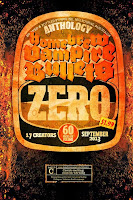
Till the new year you can download a FREE digital version in pdf of Home Brew Vampire Bullets
 Homebrew vampire Bullets Zero


And till further notice you can download the full Game of Kings book in ePub for your digital reading device For absolutely nothing.

Monday, 16 December 2013

DETHKLOK ‘Metalocalypse: The Doomstar Requiem A Klok Opera

Metalocalypse: The Doomstar Requiem A Klok Opera
Things have been pretty lean this year in the area of virtual,cartoon bands.
The promise that was PUSHER JONES never eventuated and Gorillaz are as good as sunk, even though there is apparently 2 albums at least in the boot left over from Plastic Beach. However,,,,, The good Ol' Boys from DETHKLOK have come up with the goods with this one hour special shown in October via Adult Swim
CATCH IT ALL HERE (or HEAR its only the music) looking forward to the DVD release.