Wednesday, 11 December 2024

Merry Christmas 2024 A free Gift.

To celebrate this Christmas I am proud to offer this wonderful Aussie Indie Comic Scene 'Zine that has just been released for Christmas. And to make it an even better celebration, it is available as a free download.
JUST CLICK ON THE IMAGE. (pdf 35MB in size)
The brainchild of Reverie Founder Gary Dellar, this 'zine is packed with information and articles on comic collections, historical articles, pieces on creative process and some current happenings in the Indie comic scene. I was very proud to be a part of this project and Issue Two is all ready to come out in the new year. A great read and a must have for those interested in Aussie comic history, looking to get into comic creating or just love a good informative read.
The limited edition  physical copies has nearly sold out. If your keen for one CLICK HERE.


 Here's the blurb of the projects success from Reverie founder Gary Dellar.

Exciting Success for Comics & Cartoonist Australia #1!
We’re thrilled to announce that Comics & Cartoonist Australia #1 has been a tremendous success! To date, over 540 digital PDF editions have been sent out, and the limited print run is nearly sold out.
It’s amazing to see how much interest this first issue has generated, far beyond what I ever imagined. Is it simply the magic of a debut issue? They do say the first issue always sell well, but the real question is: will the momentum carry forward? We’ll soon find out with the second issue!
Thank you all for your incredible support. This journey is just beginning, and we’re excited to see where it leads!

Monday, 2 December 2024

Christmas Songs You Didn't Ask For.

 Christmas Songs You Didn't Ask For.

Merry Christmas


Friday, 1 November 2024

My Cabinet of Curiosities.


My Cabinet of Curiosities.

If you are a collector these days, regardless of your occupation, hobby, or obsession, there are many resources and avenues for you to pursue your passion to add, enhance, or complete items for it. The popularity of Antique Malls, Collector Fairs, and of course, the Internet & eBay have made access to hard-to-find items of collectors a lot easier than ever before.

Now think back to an earlier time when collecting meant not remembering but revealing things never seen before. A trophy case of a different kind.

Imagine a world without mobile phones, computers, or smart TVs. Nary a book to be found either, unless you were wealthy. How would you entertain your guests after dinner without the aid of any of these devices? Cabinets of Curiosity were the aristocrat’s answer for those who sought to make more exciting the opulent but dimly lit parties of pre-Industrial ages.

The guests would be shown and told fascinating stories about items such as occult manuscripts, skulls of strange animals from parts unknown, pieces from some ancient ruin, death masks of criminals, and ancient bones from creatures only whispered about in fairy tales.

Cabinets of Curiosities or Curios started in the sixteenth century but gained immense popularity in the 18th Century all over  Europe and was still popular up until Victorian times. Travelers and explorers brought back oddities from their journeys, many that had never been seen before. Some were small and literally kept in ornate cabinets and shelves. Others had large pieces that filled rooms and halls. These could include elephant skulls and whale ribs.

To be clear, these collections were a status symbol, a testament to their intellectual curiosity and knowledge.

It was also a safe bet to say that some of the cabinets weren’t always built on truth. For example, some items, like the famous Fiji mermaids were made by stitching together the torso of a monkey to the tail of a fish. But a spectacle just the same. Our very own platypus was considered a hoax when it was first brought back to England as a newly discovered animal.

In time some of these collections were considered vulgar and were often disposed of on the death of the collector, while others were absorbed into established institutions that remain today such as the London Museum, Saint Petersburg Museum, Russia, the Louvre in Paris, and Smithsonian Institute.

I’ve been fascinated with these collections for years and about a decade ago decided to make my own. Not with found objects from my many travels abroad or weird scientific oddities I discovered (mainly because neither of those things have ever happened) I just wanted a shelf with an eclectic collection of weird things that looked cool and would catch people's attention when they walked passed it. I wanted to base it on one of the paintings that has always inspired me. The 1690 painting by Domenico Remps, Cabinet of Curiosities

Over the years I collected old maps and ephemera- mainly from chemist and hardware shops, little bottles, odd keychains, small weathered mechanical instruments, statues, ancient little books, barber’s tools, and spectacles. Anything that looked like it was found in a dark dingy shop owned by an old Gypsy selling potions.

To house this collection, I found an old medicine cabinet at a flea market which I wethered and stained to age it appropriately and then added some extra nooks and brass ornaments.

I was happy with the end result and continued to add when on the occasion I picked up something fitting.

Is it all real? No. But everything needs to have a story.

Are the stories real? Does it matter? No. Like all true Cabinets of Curiosity, never let the truth get in the way of a good story.

As a writer, I find it a great inspiration to build a story.

This was often the basis of the original collections. Guests would gather after dinner whilst their host regaled them with the compelling tale behind each object, Usually enhanced, and most probably about an item they got from some merchant or traveler and had no idea of its true providence.

One thing about the Curiosity Cabinet, not just mine but all, is that they have no labels. This is to ensure the knowledge, that the keeper of the curios is the owner of the story. This is one of the reasons why museums became popular, replacing many privately owned Curiosity Cabinets and having detailed descriptions so that the mystery was shared.

The need for some to collect and show off inspired Curiosity Cabinets, which in turn established the modern museum as we know it today. Everyone who collects has their own potential museum. Something they enjoy personally or are willing to share their gained knowledge with. Either way that can never be a bad thing.

Tuesday, 1 October 2024

We all collect Yellow Submarine Stuff.


We all live in a collect Yellow Submarine Stuff.

I think we all at some time have collected things.

From the physical like stamps, records, and books to ethereal things like memories.

The reasons for collecting are many; things we once had, that were broken, lost, or that we or our parents couldn’t afford when we were younger. Its sphere is all-encompassing.

Collecting can be exciting and challenging, with a physical goal to achieve, the dopamine hit of finding that treasure. It is also something that can vary greatly in scope and size. From something you may keep in a box in the wardrobe to a curated collection, with documented histories and records. To have accounts of one’s legacy with hopes to pass on.

Collecting isn’t just something that carries on from your childhood. It develops over time.

I have amassed several collections over the years, some intentional, some just accumulating without me realizing.

My unique collection would have to be my compilation of all things  Yellow Submarine-related. This fits into the ”…accumulating without realizing” category.

When I was a pre-teen, during the school holidays my brothers and I would be put on a bus and sent for a week or so to various Aunty & Uncles in the Yea/Murrindindi area, where my mum originally came from and most of her large family still resided. On one of these trips, I had a comic to read, who or what I have no recollection but at the back was an advert for the Beatles' new Movie and the comic that was part of the marketing campaign. The comic was in colour, so it must have been an import. But the art, the characters, and the style of the few pictures featured on the two-page spread had me spellbound. I had never seen this kind of creative style and I wanted to know more about it. I had an exercise book and colouring pencils with me and began to copy the magical pictures, and during the course of my stay, started making up my own story with the characters. Of course, without any new material feeding this obsession, it quickly faded. I had to wait a few years when the original Yellow Submarine movie was shown on TV. This time I was a teenager, Colour TV was a thing, and I was a bit more into music. I was anticipating something great and I was rewarded many times over. Wishing with all my heart, that there was some kind of device to record it on so I could watch it repeatedly. Even though through the ages I did rent it on VHS many times, as time went on, I had other interests that far exceeded obsessing about an old 1960s band cartoon movie. Then at about the turn of the new century, I stumbled across some figures in a toy store sale bin. John and George, I think it was, dressed in the Sgt. Peppers gear from the movie. I thought they would look good on the shelf. From that point on, my radar seemed more attuned to this kind of item. This led to some old VHS tapes, then I managed to get an actual model of the Yellow Submarine itself.

Time rolls on and now I have seven, as well as posters, books, comics, trading cards, and DVDs. Along the way, I also managed to pick up an appreciation of Sgt. Pepper and Magical Mystery Tour period pieces. Once again because the theme and art appealed.

It must be noted, that I am not a real big fan of the Beatles’ music. though as a musician. I wholeheartedly accept their role and influence on music to this day. I have never been one to let the music of my youth dictate my musical taste, I am always on the lookout for something new and exciting, however, my artistic preferences and influences seem to work in the opposite directions if you take in what I have just written here.

 I  have watched other collectors show off their collections on YouTube and was amazed at the amount of merchandise that was released over the years, making my effort seem tiny. I however was disappointed that most of these collectors hadn’t even removed the plastic on the boxes of their figures, kits, cards, and models. I don’t understand how they couldn’t fight the urge to hold them and enjoy them.  

I haven’t added to the collection for some time now, but when I do stumble across something Yellow Submarine related, that old feeling of yesteryear surfaces once again and I automatically think  “I wouldn’t mind holding that”.

Originally published in BBCN Issue 336 Sept 2024


Sunday, 1 September 2024

The Game of Kings

 The Game of Kings was an art project developed by Simon Sherry back in 2007 on the redbubble art site..

I wrote the libretto that featured many artists from Australia and the UK.

This is a movie of the storybook, so you may want to pause to read.

For individual action sequences check out the Game of Kings playlist on the same YouTube channel.


Friday, 2 August 2024

Melbourne's Olympic Legacy Part 2

  Melbourne's Olympic Legacy Part 2


Last month I wrote about the 1956 Melbourne Olympics venues and their eventual providence, this month I visited the place that housed all the athletes and officials who performed in those stadiums.

The Melbourne Games were the first in history to house the athletes in a specialty location as opposed to dormitories as other host cities had done previously. For Melbourne the athletes would be allocated their own apartments, or as it turned out semi-detached houses and flats. This wasn’t just a large building like a hotel but a whole suburb. Thus, creating the now common term Olympic Village. This wasn’t the only game changer, not only was it a new development it was also the first time male and female athletes would live in the same compound, albeit separated by a wire fence. Given there were some 3300 athletes, the male-to-female ratio was almost 9 to 1 (this doesn’t include the other 1200 or so officials of both sexes, who also shared the accommodation)

It may seem innocent now, but an Olympic village full of fit young athletes in the 1950s and having both males & females living together was considered a radical social experiment.

A rumour going around during the games was that a Greek pole-vaulter used his talents to clear the fence looking for female company.

 Several nations chose to boycott the Friendly Games -as they were dubbed- with heightened global tensions with the Cold War and the Suez Canal crisis dominating the media.

 All up 67 countries competed but one country chose not to stay at the Village, at first.  For security reasons the USSR team refused the Village and were housed on a Soviet freighter docked a Port Melbourne. The USSR had invaded Hungary to quell a revolution less than two months prior to the Games. However, diplomacy won over.  It was reported: …the USSR was persuaded to relocate to the village. It proved an inspired move. The Cold War protagonists got on famously, apparently indulging in vodka and rock n roll parties, and going on joint excursions.

With this kind of reaction, you can see how the Olympic Village became the mainstay in the planning of future Olympic Games.


After the Games, the compound in West Heidelberg, now exclusively referred to as  Olympic Village was allocated as public housing, and became a Housing Commission area, the architecture similar if not identical to other areas developed at the same time from Doveton to Broadmeadows and Jordanville to Sunshine. It also suffered the same sort of disadvantages these areas tended to attract by the early 1970s.

My In-laws live in Reservoir and I have to drive through West Heidelberg to get there, So, recently I decided to take a quick look at what once was the athletics village of the Friendly Games. After all these years I never realised I only had to turn left at one set of lights and I was there. Having studied photos from the era, I found the main entrance instantly recognisable.  Mainly because of the prominent Olympic rings over the road where the original entrance was. What was the old police station and administration buildings is a strip of shops and a community centre. There seemed to me, that there was a level of ignorance by the building committee of the day, as they had named all the streets after events, vessels and places from the recent World War, in particular the Pacific theatre.. 

Not very fitting for an event meant to draw nations together. Driving down under the rings (Alamein Road) takes you directly into the original village. I say original because unlike most Housing Commission areas, which have many of their older buildings replaced with more modern dwellings, many of the 1955 flats and houses still stand. The reasoning behind this may be that Olympic Village was predominantly brick construction, whilst areas such as Jordanville and Doveton were fabricated concrete and were only ever expected to last 40 -50 years. The other thing that struck me driving around the tight and curved road with lots of parks and open areas was ”Did they really fit nearly 5000 people in this little area?”  

By today's standards, it’s hard to imagine this being the latest in modern accommodation for elite athletes. But then I had a cheeky thought. They were just amateurs after all. (anyone who plays amateur sport and has to travel will not see the humour in this) This as an aside, the athletes of the sixteenth Olympiad gave the complex a resounding thumbs up and the village was considered a huge success and a massive hit with those staying there.

The area where the shops are littered with markers and monuments to the 1956 Games is quite interesting not just the information you can learn but how many different commemorations there have been since the Games were held. I recommend, if you are driving through this part of town take the detour. It’s great reliving a wonderful part of Melbourne's history that is quickly coming up to celebrating its 70th Anniversary.


Tuesday, 2 July 2024

Melbourne's Olympic Legacy Part 1

 Melbourne's Olympic Legacy Part 1


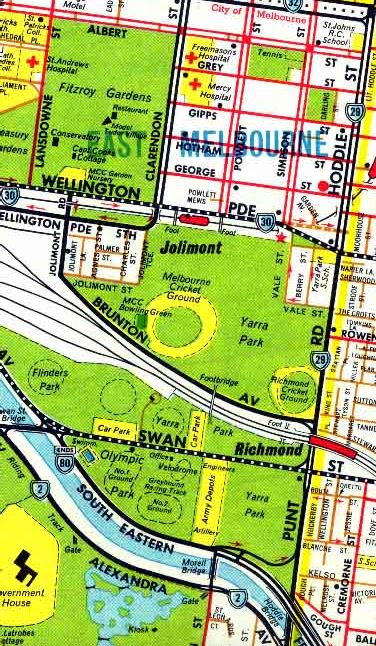
1965 Aerial view of District

The Olympics is nearly on us again, even though it wasn’t that long ago we experienced the crowd free Co-vid effected Tokyo Games, this years Paris Olympics are greatly anticipated by even those who don’t really follow sport that much

 With the build-up to the Paris Games, I decided to have a look back on the legacy of the 1956 Melbourne Games. Growing up in the 1960s & '70s, I visited a lot of the venues, watched them be repurposed, and in some cases, demolished.

Melbourne won hosting rights in 1949, beating Buenos Aries by a single vote. The Melbourne Cricket Ground was to be the main venue and centrepiece. By the time Melbourne was chosen, it had already existed for close to a century and was already a major landmark. Situated in a central position close to public transport, it was also adjacent to one of our city’s founding fathers’ fortunate decisions.

Across the railyards where most of the city’s Olympic legacy lies.

Nearly seventy years ago, Melbourne already had a dedicated sports precinct where many of the events were held, Having already existed since 1896 and well placed, These venues just needed some attention, slap a ring logo on them and our city had its own Olympic Park next to the city centre, one whose location still exists today. Throw in a ready-made workforce returned from the war. Melbourne was set to build.

A dedicated sport and recreation area since the 1860s, the realignment of the Yarra River in 1896 created the park as it is today.


1966 Map of district
Originally an area of multipurpose activity. The fields were used for all types of sports at one stage a  motordome was built which hosted motorbikes on the track and Aussie rules, wrestling, rugby union, and dirt bikes on the in-field. The motordome was torn down in the 30s and replaced by a boarded cycling track and was renamed ‘Olympic Park’, predicting its eventual use by 20 years

Once, Olympic Park was modified again, with two arenas (Conveniently called Ground 1 & 2) and an improved velodrome installed plus hockey and soccer fields. The one major structural addition was the Olympic swimming pool, erected on the riverbank at the park’s western edge.

So, as you can imagine Olympic Park was by far busier than the main stadium (MCG) hosting all swimming, diving, water polo, hockey, soccer, and nonroad cycling events

This is how I remember the area as I used to catch the train into the city. All the buildings were on full display as you passed through the Jolimont railyards. The Swimming Centre still displays the Olympic Rings. By then though Ground 2 had been transformed into a Greyhound track, with Ground  1 becoming our premier track and field and Soccer venue. The Velodrome fared less well, becoming a car park.


2024 Map of district
These days, of course, it is a world-famous sports precinct including the Tennis stadiums, AAMI Park (velodrome/Ground No.1), and Collingwood headquarters main training track (Swimming centre/ Ground No.1). All venues all doubling as entertainment venues from Rock shows to Opera and Monster trucks to Circus’ as well as major sporting codes.

Other venues for the 1956 Games were the Exhibition Buildings, which due to heritage protection still remains as it did in 1956, almost the same as it did in 1888 for that matter. However, for the Olympics, a stadium annex was built, which along with some temporary seating, was all that was needed to prepare the venue for hosting the basketball, wrestling, and weightlifting.

Another unspoiled venue is the St. Kilda Town Hall which hosted the Fencing.

Festival Hall in West Melbourne, was the host of the Boxing and Gymnastics.

When I was growing up Festival Hall was the major events venue for bands, housing shows from the Beatles, Rolling Stones to Frank Sinatra and Liberace. It nearly wasn’t an Olympic venue as it burned down in 1955 but was quickly rebuilt in time for the Games. It has been upgraded to a more modern facility and it still operates today.

The Sailing was held in Port Phillip Bay, which is obviously still with us today and all the rowing was held in Ballarat on Lake Wendouree, though it had its problems getting ready and complying with international regulations it was a hugely successful event for Ballarat, even though Australia won no medals. I first visited it in the drought years of the mid-2000s when it was virtually a field, but going back recently and seeing it full made me realize how wonderful and idyllic a venue it must have been.

The Shooting was held at the Williamstown Rifle Range, it is now a housing estate.

Venues used for 1956 events

The modern Pentathlon was held in three venues, shooting at the above-mentioned Rifle range, fencing at St Kilda, and two other disciplines, swimming and running at Olympic Park, whilst the show jumping was held at Broadmeadows at the Oakland Hunt Club, which still exists today as a riding school. It was the only sport where horses were used in the Melbourne Games as local horses were supplied for the athletes. All other Equestrian events were held in Stockholm Sweden due to Australia’s strict quarantine laws. Something that doesn’t seem as much a problem these days, judging by the amount of foreign horses in the Melbourne Cup.

Originally published in BBCN Issue 334 July 2024