Saturday, 3 October 2015

YE OLD BLUES PROMOTIONAL POSTERS


These Paramount Records print ads span from 1927-1932 and were originally printed in the Chicago Defender. Paramount Records began around 1910  in a Wisconsin furniture company that began pressing records in hopes that’d help them sell record players The  company curated and released a  legendary catalogue of classic early jazz and Delta blues 78s by the likes of Charley Patton, Ma Rainey, and Blind Lemon Jefferson.
I just think they look spectacular.


originally ran in the Dangerous Minds blog
Go to this site for links and a more comprehensive history of these classic pieces of art

Wednesday, 16 September 2015

FERNDALE - In search of...

FERNDALE
A century ago the Dandenongs above the Basin were the homes of several large country estates. They were residences of successful businessmen who had profited from a booming Melbourne of the late 19th Century. Two in particular have reached almost legendary status for their Swiss chalet design and sheer size of the buildings. Today barely a trace survives of these majestic residences that were victims of fire, flood, taxes and time.
One of these was Doongala situated high in the hills in what is now national forest the only physical  remains now being the front steps, an old well which is still visible but safely enclosed by a fence. There is bluestone embedded into the batters of the road leading up to the old property and several hundred metres below that the site of the old stables. The gardens terraces are still visible to those with a touch of imagination. It’s a lovely place for a picnic but to sit in the quiet of the bush and release this house had several owners and was rebuilt several times - the first time because of a flood another by fire- is quite fantastic. I wrote about Doongala in the April 2014 issue of the BBCN- because I had to get a personal feel of where these mighty houses were built and how hard it must have been to move materials up the steep tracks and see if an thing remained of the awe inspiring gardens the families had created amongst the bush.
To see Doongala now and know that it was self-sufficient in most things and had large servant’s quarters for house staff, gardeners, smiths, stable hands and drivers. It is hard to imagine it existed within this steep heavily wooded area and basically completely gone by the mid-1930s. So much activity and lives lived at a time down the road Boronia had less than 650 full time residences and that was with a railway station. Because few pictures survive and plans of the property rarer, it is worth the trek up the track to visit the site and check out the information board as it has some illustrations of the house in its former glory.
Ferndale looking up towards Ferndale Rd
The second of these Swiss chalet inspired houses Ferndale belonged to James and Emily Griffiths, James being one half of the famous Griffith Brothers and the Griffiths Tea Company. In 1880 He and his wife Emily constructed Ferndale a three storey Swiss-style home (about two kilometres as the crow flies from the Basin Triangle Park) it had 17 main rooms including 11 bedrooms, these were complemented by three bathrooms, three studies, numerous laundries, workrooms and maid’s quarters.
Like Doongala it also had cottages for the labourers and farmhands who tended the animals, orchards and gardens. It was these many
James and Emily Griffith
orchards, large livestock holdings and gardens that made Ferndale self-sufficient. Ferndale also used the mountain slopes to incorporate a water reticulation system by damming the creek above a natural waterfall and running large pipes to the property. Ferndale’s gardens were believed to be quite a spectacle with many special features including heavily ornamented entrance gates, which opened into a bluestone courtyard complete with fish pond and fountain. Lawns complimented garden beds adorned with many varied flower species with a special area that showcased chrysanthemums. Sadly not a lot of photographs or memories are recorded of Ferndale’s glory days but local historian Rick Coxhill in his wonderful History of The Basin papers managed to interview Frank Grumont who worked at the property and leave us with his memories of Ferndale in its heyday. His descriptions of Ferndale painted in white, gold and brown conjures up a striking contrast to the lawns and gardens and the natural bush background. Ferndale’s demise came shockingly quick with the tragic death of James and Emily Griffith in 1925 when their carriage (Though it was the mid-1920s and the Griffiths’ could easily afford one James Griffith disliked automobiles and travelled in a horse drawn carriage) was hit by a train whilst crossing the line on Mountain Highway in Bayswater. Griffiths left a will that bequeathed his assets to his wife Emily. However, Emily did not die until four days after the train collision and consequently two sets of death duties were payable on the estate. The estate passed to Griffiths’ next of kin who could not afford to pay the death duties, Thus the land and house had to be sold to pay duty on the large house and business.
When eventually it was sold and a large area of land surrounding the house was portioned off and part of the rest of the property was subdivided into over 100 blocks of land. Ferndale on these smaller surrounds became a popular guesthouse up to the Second World War shortly after it was used as a migrant hostel before falling into disrepair in the 1950s. Ferndale was eventually burnt to the ground during the infamous January 1962 fires that were deliberately lit near what is now Wicks Reserve and nearly took Olinda and Sassafras and resulted in lives lost and large property loss. The house was situated on the western face of the Dandenongs with the mountain as a background and commanded an excellent view overlooking the Dandenong valley and the eastern suburbs of Melbourne.
The 100 sites and the Ferndale Estate proved a disaster and eventually land above the premises was bought by the Government and returned to the National Park. With a bit of research it was easy to find the original location of Ferndale and I felt the need to visit the site myself and see if anything remained.

1947 Map showing original entrance
So one very cold and blustery Sunday in July I headed up the Basin-Olinda road turning off at Old Coach Road and there it was Ferndale Road, there was a little spot to park the car in front of a Yarra Valley Water tank that a lot of hikers and bush walkers use and I wandered up what the big sign nailed to the lamppost said Road Closed. A short walk up the road cut into the side of the hill you are instantly aware which side of the road is National Park (up -East) and which is private property (West –down). I was aware that the road was gated about 400 metres down for Parks Victoria access and hoped I didn’t have to do any unnecessary climbing when a saw what I first thought was a wooden panel shoring up the embankment. To my surprise it was a rather ratty looking notice board with laminated notes and photos. I may have said the board looked ratty but the information that it contained was priceless snippets of the Ferndale property and history. I spent so much time looking over the board that when I looked up I hadn’t realised that where I stood was the view that Ferndale was famous for. Looking out between the trees was a gap that looked over the Basin and the Eastern suburbs all the way to the city skyline. Even on an overcast day like that day I visited it was stunning. Thanks to the photos on the board, I got a clearer impression of the wonderful work that had been done to build the gardens and lawns. I also managed to answer a question that I couldn’t seem to find anywhere else. That Ferndale’s entrance was off Old Coach Road despite claims the property was always referred to being on Ferndale Road. I knew this must have been wrong as Ferndale Road sits so much higher in photos and would have made access very difficult, especially after such a steep incline to reach it. The entrance was also confirmed later from information gleaned from a 1947 tourist map I found just prior to writing article and also from an interview with Frank Grumont where he mentioned Ferndale Road was put in after the subdivision. On the roadside board there is a picture that featured on the cover of the original Ferndale Estate brochure. It was a view bracketed by two massive conifers overlooking the house roof and chimney out towards what then 1920s Melbourne. I felt I was standing in the same position that photographer did almost 90 years previously.

The picture that gave me a clue to the location of Ferndale,


I paid a visit to the wonderfully helpful people at the Knox Historical Society the next week to ask if they had any knowledge who may have set up the board but as a group they were unaware it existed and talked of driving up and seeing it for themselves. While I was there I got a peak of some of the group’s archived photographs of Ferndale and some more glimpses of the beautiful well-maintained property it once was. If anyone does have information regarding who may have set up the board on site could you please contact this paper or the society? I strongly suggest it be added to the Knox Heritage Trail. We have many hidden treasures with such wonderful history in our backyard and learning about Ferndale’s was a fun challenge for me and I know there is much more to discover, one of the many benefits of living in the foothills of the Dandenongs. If you want to learn more about Ferndale and the Griffiths family the Knox Historical Society has a neat little exhibit at the museum situated at Ambleside where all the photographs mentioned here and more can be viewed.


The board on Ferndale Road


The board with a glimpse of the amazing view behind.


 References and Further Reading. 
Fire on the Hill, Flowers on the Valley 1992- Rick Coxhill The History of the Basin.- Rick Coxhill 2001-Ongoing www.coxhill.com 
BBCN July-September 2004 issues 139-141 Articles:Frank Grumont and the Fendale connection. Ferndale Memories 
Story of the Dandenongs- Helen Coulson FW Clarke 1958 
Prolific in God’s Gifts – Michael Jones Allen & Urwin 1983 
Knox Historical Society- Ambleside FTG. http://home.vicnet.net.au/~khsinc
Originally published in BBCN issue #237    September 2015

Tuesday, 1 September 2015

Jack Spratt review

JACK SPRAT E-Magazine FIRST ISSUE REVIEW
Jack Sprat Press
Edited by Emily White

The Fanzine becomes E-zine
That’s about it really with the use of modern technology the fanzine has come a long way from mimeographed sheets stapled together. Boomed with the easy access to he photocopiers and then the desktop printer. Now we seem to have moved onto to the next phase.
Handmade and designed ‘zines for your Kindle.
Jack Sprat calls for the dark and whimsical through Flash Fiction and short four page comics. Speculative fiction and shorts  in the vain of 2000AD - Tharg’s Future Shocks.
The first issue is a mix bag with some hits and a few misses. The rather tentative theme of this issue is music with each story and artwork being inspired by a song title. Obviously I don’t listen to the dark corners where these songs are played because I didn’t recognise any of the titles. But that is neither here nor there as the first story Bring Me To Life is lovely little spin on the Pinocchio fairy story. While A Tea Party gives us an amusing look at zombie good taste in more ways than one and looks at the Walking Dead from their perspective, one we can never really understand. The Sky Is A Poisonous Garden a quick dark humour ditty that reveals some people have no luck whatsoever.
Where the stories hit the comics miss. Choosing story over art only one of the three stories worked for me. Silent Falling the telling of how an Astronaut chooses to go out in glory and is the closet to a Tharg based story, whereas Started From The Bottom is a punchline looking for a story, the non-dialogue The Burning Bride just lost me.
All up Jack Sprat is finding its identity and for a first attempt it’s admirable. The concept works. This is the perfect package for a bus stop or waiting room pause.

Danny Nolan


Monday, 3 August 2015
Comics and how some times language of the period doesn't translate that well.

Comics and how some times language / slang of the period doesn't translate that well.
As far as I know all these panels and covers are legitimate.
Sorry for lack of credits as these have been piling up from bits I've been saving as I found them from facebook posts from over the last few months.


Saturday, 4 July 2015

Passion Pictures Beatles Rock Band cinematic.


 From the people who brought you many of the GORILLAZ clips, this is the opening cinematic of the video game Rock Band featuring songs by the Beatles. Though on close inspection you could be forgiven for thinking Jamie Hewlett had a hand in this but sadly he is nowhere to seen in the official credits. Look for the dozens of the Beatle song Easter Eggs scattered all through the video. It'll take a while to find them all, if possible.

The Beatles Rockband Intro from Stephane coedel on Vimeo.


ADDITIONAL EXTRAS This the end cinematic from THE END from the Video Game 
 HOW THE BEATLES ROCKBAND WAS MADE. HOW THE CINEMATIC WAS MADE.
 THE MAKING OF: PART ONE

PART TWO
 
PART THREE

Thursday, 25 June 2015

Jamie Hewlett's new Gorillaz pics

Jamie Hewlett is busily drawing and releasing pictures of Gorillaz members on Instagram.
They're changed somewhat since  the bands last release six years ago.
Judging by their dress the members seem to be evolving and finding new styles as time passes. It's good to see Russell has be cured of his waterborne gigantism.
The drawing of Noodle is just exquisite.

Friday, 5 June 2015

FREE COMIC BOOK DAY 2015

FREE COMIC BOOK DAY


 If you’re ever reading an article about comics that starts with: “If you thought comics were the domain of young children you may have a surprise coming”. Turn the page, the only surprise you’ll get is the author didn’t research his topic very well. Comics’ audience stopped being the sole property of children and teenagers decades ago; the popularity of comic books only has to be gauged by the amount of high grossing and very expensive movies that are based on comic characters. Three of them are in the Top Ten highest moneymakers in movie history. Comics are a serious business. They are a lynch pin in the multimillion dollar geek/popular culture scene that incorporates movies, television shows, cosplay (dressing up as your favourite character) model making, video and Role Playing games and collectables among many other activities and hobbies. Australia alone has nine conventions a year in most states to cater for the popular demand that followers of pop culture slavishly seek out. 

 It’s not to say that comics aren’t for children anymore, not by a long shot, It’s just that those kids in the 1970s 80s and 90s didn’t give up reading them and created a whole new audience. During the 1980s comics went through somewhat of a renaissance when many British writers moved to the United States and re-imagined old and tired characters. This British Invasion led to change in the industry that moved artists and writers working at page rates and actually owning characters they created. The whole comic industry is littered with tragic tales and some are only being reconciled some 50 years later – but that’s a whole different story. During this renaissance new terms entered the language. The graphic novel and sequential art to describe what was considered throw away cheap ephemeral comics. Many went on to become classics with Alan Moore’s Watchmen comic actually appearing in TIMES top 100 novels of the 20th Century. In 2001 a Californian Comic retailer Joe Field was writing columns for an industry magazine, and saw how successful feature films based on comic book franchises were providing the comic book industry with a positive cultural and financial turnaround. This idea was Free Comic Boy Day and was so effective that in its first six years; more than 2000 retailers in more than 30 countries gave away more than 12 million Free Comic Book Day special edition comic books. It is now an anticipated yearly event especially here in Australia.

 I myself have been an avid comic book reader since I was in Primary School and I have my father to thank for that who in his 40s still enjoyed Phantom and Batman comics. I was also lucky to live near Gordon and Gotch Magazine distributors in Burwood who would throw out any comics damaged or sent back from Newsagents. These free black and white reprints of US titles could be picked up in bulk from the on-site store. From there I never really stopped, I am still an avid collector today as well as a contributor to the local scene. Thanks to the Internet and computer based graphic programs there are now many Australian’s at the forefront of worldwide comic creating fame. Artists such as Tom Taylor and Nicola Scott who work on popular superhero titles for DC and Marvel comics and Tristian Jones who has worked on Teenage Mutant Ninja Turtles and Ghost Busters have huge followings. These artists can often be seen at the larger city stores on Free Comic Book Day doing free sketches and signings for fans in the spirit of the day. 
Free Comic Book Day has three main purposes:
 1) To introduce everyone to the joys of reading comics. 
 2) To call back former comic book readers.
 3) To thank current comic book buyers for their continued support. 
Publishers produce special edition comics geared to attracting new non-comic readers. There is a wide diversity of comics available, from traditional comics fare like Archie and Disney, super-heroes from Marvel and DC (Referred to as the Big Two and responsible for the most famous of characters and the majority of Superheroes like Superman, Batman, Spiderman etc.) and Manga as well as work from independent publishers.
The unimposing Alternate Worlds entrance
The days haul of freebies
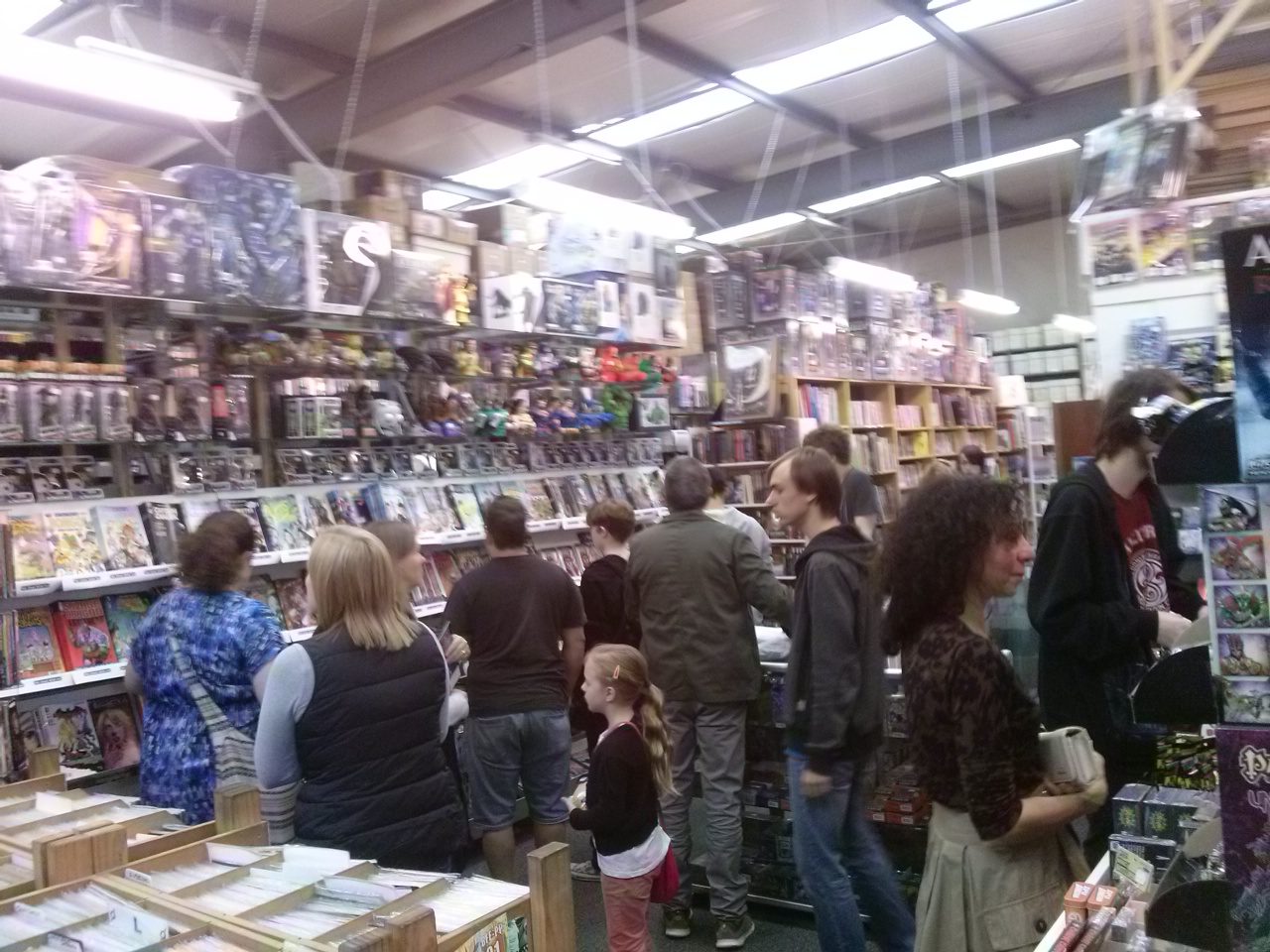
The crowd

 While the larger city stores have the big name artists in store to promote the day I like to pop into my local comic book store or LCB as they are known. Tucked away in the Industrial estate not far from Scorsby road in Bayswater is Alternate Worlds, though they don’t have a stable of local artists sitting around trestle tables and queues around the block that still embrace Free Comic Book Day with an enthusiasm that has the shop packed with people checking out what’s on offer. Peter Hughes the shops co-owner says he looks forward to and enjoys the day and judging by the crowds it is one of the major days on the calendar. Operating in one shape or another since 1977 and being based in its current location since 2011. Alternate Worlds releases and sells comic books the same day as those released in the United States, which is usually every 
Peter Hughes
Thursday so the amount of titles is constantly changing. One of things I like about Alternate Worlds is it position. The entrance is in the corner where two buildings meet. At first it seems it is a doorway to a passageway because the businesses either side seem to occupy all the other space. It’s only when you walk through the door that you realise it opens up – almost TARDIS like - to a larger space. An Aladdin’s cave of shelves filled full of books, toys and collectables. On the day it was crowded but I could still catch up with some likeminded people for a chat and to top it off I came out with a lot of free quality comics to read and put off doing the lawns for a few more hours. Free Comic Boy Day is a yearly event that falls on the first Saturday in May. 

You can find out more about Alternate Worlds on www.alternateworlds.com.au. 


References: Wilkipedia, Bleeding Cool
This article originally appeared in the June 2015 issue of the BBCN