Tuesday, 1 September 2015

Jack Spratt review

JACK SPRAT E-Magazine FIRST ISSUE REVIEW
Jack Sprat Press
Edited by Emily White

The Fanzine becomes E-zine
That’s about it really with the use of modern technology the fanzine has come a long way from mimeographed sheets stapled together. Boomed with the easy access to he photocopiers and then the desktop printer. Now we seem to have moved onto to the next phase.
Handmade and designed ‘zines for your Kindle.
Jack Sprat calls for the dark and whimsical through Flash Fiction and short four page comics. Speculative fiction and shorts  in the vain of 2000AD - Tharg’s Future Shocks.
The first issue is a mix bag with some hits and a few misses. The rather tentative theme of this issue is music with each story and artwork being inspired by a song title. Obviously I don’t listen to the dark corners where these songs are played because I didn’t recognise any of the titles. But that is neither here nor there as the first story Bring Me To Life is lovely little spin on the Pinocchio fairy story. While A Tea Party gives us an amusing look at zombie good taste in more ways than one and looks at the Walking Dead from their perspective, one we can never really understand. The Sky Is A Poisonous Garden a quick dark humour ditty that reveals some people have no luck whatsoever.
Where the stories hit the comics miss. Choosing story over art only one of the three stories worked for me. Silent Falling the telling of how an Astronaut chooses to go out in glory and is the closet to a Tharg based story, whereas Started From The Bottom is a punchline looking for a story, the non-dialogue The Burning Bride just lost me.
All up Jack Sprat is finding its identity and for a first attempt it’s admirable. The concept works. This is the perfect package for a bus stop or waiting room pause.

Danny Nolan


Monday, 3 August 2015

Comics and how some times language of the period doesn't translate that well.

Comics and how some times language / slang of the period doesn't translate that well.
As far as I know all these panels and covers are legitimate.
Sorry for lack of credits as these have been piling up from bits I've been saving as I found them from facebook posts from over the last few months.


Saturday, 4 July 2015

Passion Pictures Beatles Rock Band cinematic.


 From the people who brought you many of the GORILLAZ clips, this is the opening cinematic of the video game Rock Band featuring songs by the Beatles. Though on close inspection you could be forgiven for thinking Jamie Hewlett had a hand in this but sadly he is nowhere to seen in the official credits. Look for the dozens of the Beatle song Easter Eggs scattered all through the video. It'll take a while to find them all, if possible.

The Beatles Rockband Intro from Stephane coedel on Vimeo.


ADDITIONAL EXTRAS This the end cinematic from THE END from the Video Game 
 HOW THE BEATLES ROCKBAND WAS MADE. HOW THE CINEMATIC WAS MADE.
 THE MAKING OF: PART ONE

PART TWO
 
PART THREE

Thursday, 25 June 2015

Jamie Hewlett's new Gorillaz pics

Jamie Hewlett is busily drawing and releasing pictures of Gorillaz members on Instagram.
They're changed somewhat since  the bands last release six years ago.
Judging by their dress the members seem to be evolving and finding new styles as time passes. It's good to see Russell has be cured of his waterborne gigantism.
The drawing of Noodle is just exquisite.

Friday, 5 June 2015

FREE COMIC BOOK DAY 2015

FREE COMIC BOOK DAY


 If you’re ever reading an article about comics that starts with: “If you thought comics were the domain of young children you may have a surprise coming”. Turn the page, the only surprise you’ll get is the author didn’t research his topic very well. Comics’ audience stopped being the sole property of children and teenagers decades ago; the popularity of comic books only has to be gauged by the amount of high grossing and very expensive movies that are based on comic characters. Three of them are in the Top Ten highest moneymakers in movie history. Comics are a serious business. They are a lynch pin in the multimillion dollar geek/popular culture scene that incorporates movies, television shows, cosplay (dressing up as your favourite character) model making, video and Role Playing games and collectables among many other activities and hobbies. Australia alone has nine conventions a year in most states to cater for the popular demand that followers of pop culture slavishly seek out. 

 It’s not to say that comics aren’t for children anymore, not by a long shot, It’s just that those kids in the 1970s 80s and 90s didn’t give up reading them and created a whole new audience. During the 1980s comics went through somewhat of a renaissance when many British writers moved to the United States and re-imagined old and tired characters. This British Invasion led to change in the industry that moved artists and writers working at page rates and actually owning characters they created. The whole comic industry is littered with tragic tales and some are only being reconciled some 50 years later – but that’s a whole different story. During this renaissance new terms entered the language. The graphic novel and sequential art to describe what was considered throw away cheap ephemeral comics. Many went on to become classics with Alan Moore’s Watchmen comic actually appearing in TIMES top 100 novels of the 20th Century. In 2001 a Californian Comic retailer Joe Field was writing columns for an industry magazine, and saw how successful feature films based on comic book franchises were providing the comic book industry with a positive cultural and financial turnaround. This idea was Free Comic Boy Day and was so effective that in its first six years; more than 2000 retailers in more than 30 countries gave away more than 12 million Free Comic Book Day special edition comic books. It is now an anticipated yearly event especially here in Australia.

 I myself have been an avid comic book reader since I was in Primary School and I have my father to thank for that who in his 40s still enjoyed Phantom and Batman comics. I was also lucky to live near Gordon and Gotch Magazine distributors in Burwood who would throw out any comics damaged or sent back from Newsagents. These free black and white reprints of US titles could be picked up in bulk from the on-site store. From there I never really stopped, I am still an avid collector today as well as a contributor to the local scene. Thanks to the Internet and computer based graphic programs there are now many Australian’s at the forefront of worldwide comic creating fame. Artists such as Tom Taylor and Nicola Scott who work on popular superhero titles for DC and Marvel comics and Tristian Jones who has worked on Teenage Mutant Ninja Turtles and Ghost Busters have huge followings. These artists can often be seen at the larger city stores on Free Comic Book Day doing free sketches and signings for fans in the spirit of the day. 
Free Comic Book Day has three main purposes:
 1) To introduce everyone to the joys of reading comics. 
 2) To call back former comic book readers.
 3) To thank current comic book buyers for their continued support. 
Publishers produce special edition comics geared to attracting new non-comic readers. There is a wide diversity of comics available, from traditional comics fare like Archie and Disney, super-heroes from Marvel and DC (Referred to as the Big Two and responsible for the most famous of characters and the majority of Superheroes like Superman, Batman, Spiderman etc.) and Manga as well as work from independent publishers.
The unimposing Alternate Worlds entrance
The days haul of freebies
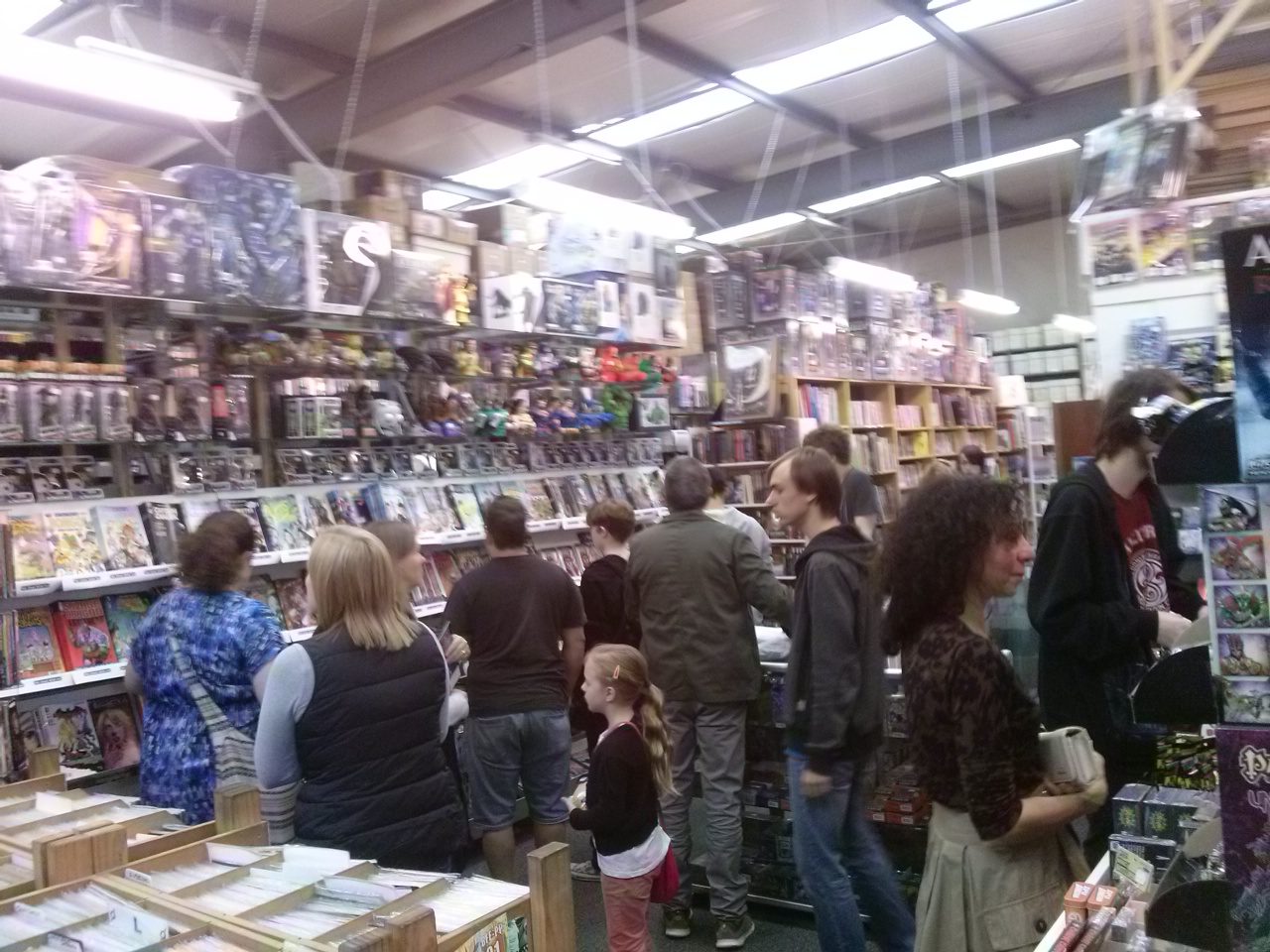
The crowd

 While the larger city stores have the big name artists in store to promote the day I like to pop into my local comic book store or LCB as they are known. Tucked away in the Industrial estate not far from Scorsby road in Bayswater is Alternate Worlds, though they don’t have a stable of local artists sitting around trestle tables and queues around the block that still embrace Free Comic Book Day with an enthusiasm that has the shop packed with people checking out what’s on offer. Peter Hughes the shops co-owner says he looks forward to and enjoys the day and judging by the crowds it is one of the major days on the calendar. Operating in one shape or another since 1977 and being based in its current location since 2011. Alternate Worlds releases and sells comic books the same day as those released in the United States, which is usually every 
Peter Hughes
Thursday so the amount of titles is constantly changing. One of things I like about Alternate Worlds is it position. The entrance is in the corner where two buildings meet. At first it seems it is a doorway to a passageway because the businesses either side seem to occupy all the other space. It’s only when you walk through the door that you realise it opens up – almost TARDIS like - to a larger space. An Aladdin’s cave of shelves filled full of books, toys and collectables. On the day it was crowded but I could still catch up with some likeminded people for a chat and to top it off I came out with a lot of free quality comics to read and put off doing the lawns for a few more hours. Free Comic Boy Day is a yearly event that falls on the first Saturday in May. 

You can find out more about Alternate Worlds on www.alternateworlds.com.au. 


References: Wilkipedia, Bleeding Cool
This article originally appeared in the June 2015 issue of the BBCN 

Sunday, 3 May 2015

Passing through history briefly- Early Australian Poets

Passing through history briefly- Early Australian Poets
From left: A.J "Banjo" Paterson , Henry Lawson, C.J Dennis and Dorothea McKellar

We take communication for granted these days, with mass media and the speed of information thanks to modern technology. A little over a hundred years ago things were a lot more restrictive.
With  no television or film as an entertainment medium, the telephone , radio and recorded music being in their infancy (I must side track a little bit here to note, that despite these limitations Australia still managed to have a bona fide global singing superstar in Dame Nellie Melba) and not readily accessible, the great communicator of the day was the written word. Newspapers, magazines and periodicals were immensely popular and because of this it was also the time of some of our greatest writers and poets.
Writers such as CJ Dennis sold 65.000 copies of his classic The Songs OF The Sentimental Bloke in 1916. If you adjust that figure for today’s population it translates to sales that would outsell the latest releases by Mathew Reilly, Bryce Courtney and Di Morressey combined.
We can take a bit of local pride in this work because the majority of it was written at Kallista in Dandenong Ranges where he stayed with friends.
The bulk of the book was originally printed (12 of 14 Chapters) in The Bulletin several years earlier as a serial. Though he sold many books Dennis found he had to still supplement his income by writing for the now defunct Herald something he did for sixteen years, he is buried in Box Hill Cemetery where his grave is still visited regularly.
The Bulletin (in which CJ Dennis first found fame,) with several other weekly journals were responsible for much of the great artistic output in the late 19th Century that is still greatly admired today. When it opened its pages to contributions from the general public in 1886 it was inundated with writings and illustrations from now legendary names such as illustrators Norman and Lionel Lindsay, the great caricaturists Will Dyson and David Low, and writers Miles Franklin, Banjo Patterson and Henry Lawson amongst others.
The Bulletin was popular because it gave it readers an Australian point of view,
Where as the newspapers of the time had a tendency to take their Editorial model from Home – as in England.
One of its originators is still causing controversy a hundred years later. JF Archibald who the greatest Australian portrait competition was bequeathed by and named after: The Archibald Prize.
The Bulletin went on to become Australia’s longest running magazine until it ceased publication in 2008 a victim of the “News Now” generation and the internet. An interesting footnote about the Bulletin that from its first edition right up to 1961 it always carried the banner “For the White Australian” something that would never be tolerated in this day and age.
The Bulletin took great delight in printing tales of the bush and of course the two greatest identities of this genre were Henry Lawson and Andrew Barton  “Banjo” Paterson.
Both were as different as chalk and cheese in the personal lives and how they wrote about their subject.
Banjo Paterson was born in Orange NSW where he enjoyed a bush boyhood and a structured family life.. When his family moved to Yass, on the main track between Melbourne and Sydney he experienced the long Bullock teams , the Cobb & Co. and the gold escorts. At picnic race meetings and polo matches he saw the skilled riders from the Murrumbidgee and the Snowy Mountains country who would put on exhibitions further feed his love of horses, horsemanship and adventure. Which he later wrote of in his bush ballads
Henry Lawson on the other hand came from a broken home and due to illness and an infection was deaf from the age of fourteen. Though his formal education suffered greatly growing up he strived to put himself through night school whilst working for his father.
Both writers took advantage of the Bulletins new editorial policy and contributed pieces that were well received. Both took different views of the bush. Though Lawson wrote some humorous pieces like The Loaded Dog, others like his classic poem Andy’s Gone a Droving and the brilliant short story the Drovers Wife tell of hardship and struggle and loss. The Drovers wife tells the story of a wife protects her children while they sleep from a dangerous snake that has slipped in the shack where they live. It goes on to recount moments in her life, how her husband has to spend months away droving to make ends meet because their once prosperous farm has been decimated by the drought. It tells of her resilience and toughness of spirit and that it was not only the men who were hard but the women and children as well. The story is considered to be one of the greatest short stories ever written.
Lawson’s work was a foil to Paterson’s work that romanticised the Bushmen, the drovers and their lifestyle. The classic Man from Snowy River is an epic poem that paints a picture of skill and daring and is so distinctly Australian it almost makes a Skippy sound when you read it. His poem Clancy of the Overflow is a beautifully metered poem that speaks of Clancy the drover (a recurring character in Paterson’s works) Paterson who lived in the city as a Solicitor tells how he longs to be back in the bush and envies Clancy’s free lifestyle and responsibility only to himself, his horse and the job he has to do at the moment.
Paterson went on to be a journalist, war correspondent and soldier during his latter years as well as being welcomed into high society, but never losing his love of adventure.
Lawson however, though hugely respected had troubles all his life with alcohol and depression, he forever had money problems and died a pauper. Despite his later years being non productive due to illness his star still shone brightly and for this recognition the NSW government gave him a State funeral and it was attended by thousands including the Premier and the Prime Minister.
Growing up during this period was a third generation Australian from a privileged background who was deeply influenced by these and other writers.
Though Dorothea MacKellar was well traveled and spoke several languages at an early age, in a bout of home sickness whilst in London at the tender age of nineteen she wrote the classic poem My Country. You know the one that has the lines: I love a sun burnt country. A land of sweeping plains.
Yeah, that one.
In a time when most still regarded England as home Dorothea was pining for what she was missing half a world away. I believe that is while it is still so well known because the sentiment expressed in it is so sincere. Like most of our pioneer poets and writers Dorothea is remembered by some form of tribute, in her case a very popular national poetry competition for schools.
Both Paterson and Lawson have appeared on our bank notes and stamps and like CJ Dennis have had their most famous writings made in films of plays.
With the popularity of Rap and its general acceptance as a style of expressive literature, there have been calls for it to replace Shakespeare in certain English literature classes due to its relevance to the youth of today. It might be more culturally significant to go back and explore some Australian classics with their well written timeless verse and prose and get a better understanding of how we developed as a nation and the spirit that drove us on to become the much envied country we are today.
This article barely scratches a thin layer of the surface of the achievements and tragedies of the great artists mentioned and has been very broad in its retelling of their lives, stories and histories due to lack of space and the large subject matter.
The turn of the last century was a golden age for Australian writing and illustration and so many have been passed over.
I just wanted to share what inspired and has interested me and I strongly advise all who read this to get on the internet or better still go to the library , grab a book and read about these amazing people and their wonderful body of work, much which is still a thrill to read in these days of a more modern language.

originally published in the Boronia and Basin Community News  April 2013 issue

Saturday, 4 April 2015

Doongalla

 Doongalla

The past glories of the Dandenong Ranges.

A look at our early pioneers who became our first elite and their lives on the Western face and foothills of the Dandenongs.

Walking around the Basin these days, especially up around the Town Centre/Triangle Park area, you could entertain the thought that it was shielded by some kind of protective bubble. It has the sleepy quality of a small country town and is unique to most outer suburbs of Melbourne that it has an English village atmosphere rather than the adjoining suburb to busy centres like Bayswater and Boronia and I doubt people not familiar to the area must get a shock when they first arrive in the Basin via these roadways.
This became more prevalent after a recent trip to the Doongalla Picnic area, the site of the once grand Doongalla Estate.
Traveling up to where the once palatial 32 room mansion once stood it’s hard to believe such a building existed what appears now in the middle of a forest, nothing left but a set of front steps.
But delving back into the history books – in this case Rick Coxhill’scomprehensive History of the Basin – among other works, I soon discovered The Basin was littered with grand houses owned by quite well known and well-to-do families of means.
These included the Millers. Chandlers and Griffiths , who where big in Racing, Horticulture, Politics and Tea respectfully.
The Basin and the Western side of the mountain would have been a great escape from the crowd and the stink that was pre 20th Century Melbourne.
Doongalla itself was originally  called Invermay and was built on top of an earlier chalet built in 1891 but damaged by flood. . The owner and builder of Invermay Sir Mathew Davies was an MP and like most MP’s of his time a land developer. Who used their inside knowledge and influence to create large fortunes for themselves and change the face of Melbourne via projects like the now dismantled Outer Circle Railway line. Davies’ wealth would be short lived as he had to hand the bank over to creditors – in his case the Bank of New South Wales- after the collapse of Land Boom in the Mid 1890s which he was more than likely an active participant and reason for it occurring.
The only remaining section of Doongalla- the front stairs.

After being tendered by caretakers for a period, the property was purchased by a wealthy Toorak women by the name of  Miss Helen Simson who was related to the prominent Melbourne Business and racing identity L.K.S McKinnon on his wife‘s side. Miss Simson was to use the property for her country residence and then went crazy spending on upgrading facilities like electricity and irrigation and establishing vast gardens. The new Land Lady must have been a women of means and haste as she paid laborers far above the going rate of the day to achieve her goals. Miss Simson didn’t live very long to enjoy the fruits of her labour and died only four years after purchasing the property. She left the entire estate to her fifteen year old niece to be administered by her father the aforementioned McKinnon. From their it just continued to change owners and caretakers until it was destroyed by a bushfire in 1932.
Though Miss Simson is credited as renaming Invermay Doongalla I found conflicting stories regarding its meaning. At the site of the old building and in Parks Victoria literature Doongalla is said to mean “Place of piece” whilst historian Coxhill claims it comes from the earlier name of the  Parish that is now Essendon named  Doutta- Galla. This is also the name of Melbourne founder John Batman’s native servant Jika Jika wife’s name. Another source says that the name Doutta Galla (or Dutigalla) was the name of the tribe of aborigines on the original Batman treaty deed, signed on the banks of the Merri Creek, at Northcote. I did find it hard to finding references for Doongalla meaning “Place of Peace” Though these days as a meaning it is very apt.
Doongalla in its heyday was so imposing it could be seen from the current round about that now splits Mountain Highway and the Basin –Olinda road. It is quite surprising with amount of money in the hills around the turn of the century and the influence of racing identities such as the McKinnon Family and another local James Miller originator of  “Miller’s Racing Guide” who also established a stud farm and full size training track that foothills of the Dandenongs didn’t become a race horse industry Mecca much like Lloyd Williams has at Macedon Lodge.
Actually looking at the pictures of the grand homes that once were dotted all over this side of the Dandenongs like Millers Homestead and the Griffith Family’s Ferndale and the original Como House, to look at the mountain now and see all the land          re-established by native forest and then at the Basin shops you would be hard pressed to imagine such a time existed and it conjures up places like boom towns that once existed in rural Victoria. Perhaps even like one of those English countryside villages that have a ruined castle that hints at a greater time in the past. Hardly any trace of the grand houses exist today, those on the mountain taken by fire and those on the lower lands swallowed by development.
What I’m saying is the Basin these days shows no hint of the grandness and privilege that was once spread through the area.
We are very lucky to have such wonderful parks and reserves on our doorstop and not bundled up behind someone’s property boundary, Funny, when you think about al the properties that were established in the area, they all failed in some way. Maybe it was the way it’s meant to be. I say that I wonder what it would be like if things turned out different but I’m very happy the way things did turn out.

 Originally published in the Boronia and Basin Community News April 2014
Remains of retaining wall of original driveway entrance
The old property well.